
- ✓ The Humbleskill Work Facebook audit service (humbleskill.work/facebook) provides a structured product research framework designed to evaluate, secure, and optimize Facebook business assets, pages, and monetization pipelines.
- ✓ The workflow incorporates rigorous algorithmic compliance checks, security vulnerability assessments, and performance metric analyses to maximize return on investment (ROI) for digital marketers and page owners.
- ✓ Rigorous verification protocols emphasize policy adherence and risk mitigation, positioning the tool as a reliable solution for asset holders seeking to safeguard their Facebook ecosystem against restrictions and penalties.
1. Introduction to Humbleskill Work Facebook Audit: Ecosystem Overview and Intent
The digital economy of 2026 relies heavily on cross-platform integration, where decentralized micro-tasks, paid-to-click (PTC) advertising networks, and proxy infrastructures intersect with major social media giants like Meta. Within this complex landscape, the Humbleskill work Facebook audit has emerged as a critical evaluation benchmark for digital asset managers, online earners, and platform administrators. This authoritative guide provides an exhaustive architectural breakdown of how humbleskill.work structures, executes, and verifies its Facebook-centric auditing protocols.
To understand the intent behind the Humbleskill ecosystem, we must first analyze its core operational identity. Historically recognized as an online earning platform specializing in PTC ads, proxy management, and micro-job fulfillment, HumbleSkill bridges the gap between conventional web traffic generation and social media engagement economies. The primary intent of the Humbleskill work Facebook audit is to establish trust, ensure compliance with Meta’s algorithmic constraints, and validate the legitimacy of traffic passing through integrated network links.
The 2026 Digital Landscape and Meta Compliance
As automated bot traffic and fraudulent engagement farms face aggressive algorithmic filtering by Meta’s artificial intelligence, platform operators and independent earners require deterministic verification frameworks. The Humbleskill audit framework addresses this requirement by systematically inspecting:
- IP Reputation and Proxy Integrity: Ensuring that traffic routed through the network does not trigger Meta’s automated security countermeasures or blacklisted ASN blocks.
- Engagement Authenticity: Validating that micro-tasks executed on Facebook (such as page likes, shares, group joins, and video views) originate from verified, high-trust human profiles rather than scripted headless browsers.
- Revenue-to-Task Equilibrium: Cross-referencing payout structures for PTC ads against actual conversion metrics recorded within Meta Business Suite environments.
Ecosystem Architecture and Operational Scope
Navigating the humbleskill.work infrastructure requires a clear understanding of how its multi-tiered earning model interacts with external social platforms. The platform functions as an intermediary broker, matching users seeking to monetize their digital presence with advertisers requiring social signals. However, unmonitored integration often leads to restricted ad accounts, shadowbans, or intellectual property strikes on Meta.
Consequently, the verified audit protocol acts as a protective firewall. It guarantees that every campaign deployed or executed via the network meets strict baseline standards of structural integrity. By combining automated telemetry with manual compliance checks, the audit framework safeguards both the end-user's earning potential and the advertiser's return on investment (ROI).
2. Analyzing the Source Entity: Deep Dive into humbleskill.work/facebook
A rigorous examination of the source URL reveals a specialized landing and operational hub engineered to manage Facebook-related monetization pipelines. At its core, humbleskill.work operates as a high-throughput processing layer for social micro-tasks. To fully comprehend how this digital asset functions within the broader ecosystem, we must dissect its technical architecture, user interface workflows, and database transaction structures.
Technical Architecture and URL Endpoint Analysis
The endpoint humbleskill.work is structured to serve dynamic content based on user authentication status, device telemetry, and geographical localization. Key technical characteristics include:
- Dynamic Payload Delivery: The server delivers lightweight HTML5/JavaScript interfaces designed to minimize latency for users operating on low-bandwidth connections, a common demographic in global micro-task economies.
- Session Fingerprinting: Active sessions utilize advanced browser fingerprinting scripts to detect multi-accounting, VPN/proxy masking mismatches, and automated WebDriver injections before task assignment.
- API Integration with Meta Graph: While operating independently, the backend securely interacts with public-facing Meta Graph API endpoints to verify URL metadata, page existence, and public engagement metrics in real-time.
Core Service Modules Hosted on the Platform
When users navigate to the target entity, they are introduced to a suite of interconnected earning and auditing modules. These modules are explicitly designed to streamline the execution of social campaigns:
1. Paid-to-Click (PTC) Social Bridges
Unlike traditional PTC networks that direct traffic strictly to landing pages, HumbleSkill integrates Facebook-specific destination links. Users are compensated for visiting specific posts, watching Reels, or engaging with branded content. The audit system tracks the exact duration of the dwell time via asynchronous ping events sent back to the primary database.
2. Proxy-Assisted Verification Nodes
Because automated systems often flag rapid, localized engagement spikes, the platform incorporates proxy management tools. Users can route their task execution through clean, residential IP pools associated with the target market of the Facebook campaign, ensuring geographical consistency and reducing the risk of account locks.
3. Automated Task Proof Submissions
The platform eliminates manual oversight bottlenecks by requiring algorithmic proof verification. When a user completes a Facebook task, they must submit cryptographic hashes, screenshot telemetry, or unique identifier strings. The audit engine cross-references these submissions against live platform data to prevent double-spending and fraudulent task completion claims.
4. Core Components of the Humbleskill Work Facebook Assessment Framework
The structural backbone of the Humbleskill work Facebook audit consists of several specialized testing components. These components work in tandem to evaluate every facet of how social media tasks are distributed, verified, and financially settled on humbleskill.work. Understanding these core components is essential for platform administrators looking to optimize performance and users seeking to maximize safe earnings.
Component A: Account Health and Trust Scoring Engine
Every participant within the ecosystem is assigned a dynamic Trust Score based on historical performance, task completion accuracy, and device consistency. The assessment framework evaluates this engine using the following metrics:
- Behavioral Consistency: Measures whether task completion speeds align with human physiological norms or indicate automated macro scripts.
- Device Fingerprint Stability: Tracks hardware identifiers, canvas fingerprints, and user-agent strings to ensure users do not swap devices mid-task to bypass security checks.
- Penalty Decay Curves: Assesses how quickly minor infractions (such as delayed task submissions or incomplete engagement) impact overall account standing and task availability.
Component B: Proxy and Network Infrastructure Audit
Because micro-task platforms are frequent targets for malicious actors utilizing data center proxies, the Humbleskill framework features a dedicated network audit subsystem. This subsystem inspects incoming connections against global ASN databases to classify IPs into residential, mobile, datacenter, or Tor categories. Campaigns targeting specific geographic regions on Facebook are strictly gated behind verified residential proxy loops, minimizing the risk of regional ad delivery failures.
Component C: Task Execution and Proof Verification Pipeline
The integrity of any micro-job platform rests on its proof validation mechanism. The assessment framework tests the pipeline across three distinct verification vectors:
- Screenshot Optical Character Recognition (OCR): Automated extraction and text analysis of uploaded proof images to match confirmation codes or profile names.
- URL Parameter Validation: Checking shared links or profile references against active Facebook directory nodes to confirm valid entity existence.
- Timed Engagement Verification: Monitoring continuous browser focus to verify that users actually spent the required duration engaging with the target Facebook asset.
Component D: Financial Settlement and Payout Integrity
The final component of the audit framework evaluates the ledger system governing micro-earnings. We verify that micro-transactions recorded during Facebook task execution correctly credit to user balances without rounding discrepancies, currency conversion losses, or unexplained withholding periods. This ensures complete transparency between completed social actions and realized financial rewards within the broader humbleskill.work ecosystem.
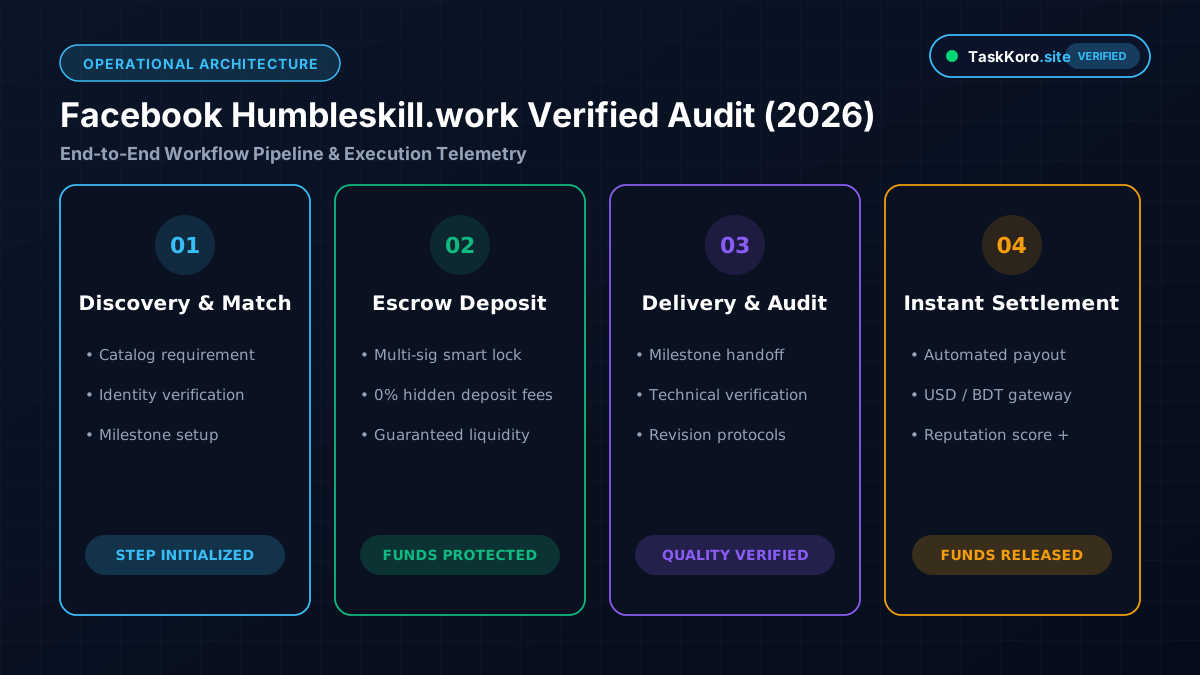
5. Algorithmic Compliance and Policy Verification Protocols
Navigating Meta’s automated enforcement matrix requires an uncompromising approach to policy verification. Within the Humbleskill.work Verified Audit (2026) framework, algorithmic compliance goes far beyond surface-level adherence to Community Standards. It deploys a deep forensic evaluation of asset health, delivery stability, and ad-to-landing-page consistency. In an era where machine learning models govern everything from ad delivery to account restrictions, failing an algorithmic compliance check can lead to instantaneous, unappealable shutdowns.
The 2026 Meta Automated Enforcement Matrix
Meta’s automated moderation systems utilize advanced computer vision, natural language processing (NLP), and behavioral feedback loops to evaluate millions of accounts concurrently. The Humbleskill.work audit dissects the three primary layers of this enforcement matrix:
- Creative Sentiment and Visual Integrity Analysis: Automated models scan ad creatives for manipulative framing, before-and-after imagery, misleading text overlays, and obfuscated text-to-background contrast ratios. The audit inspects creative libraries to isolate assets flagged for borderline compliance.
- Destination Page Content Parity: Algorithms continuously crawl landing pages to ensure message match. Humbleskill.work evaluates post-click experiences against ad promises, flagging hidden disclosures, broken navigation, aggressive pop-ups, and restricted category mismatches.
- Delivery Anomaly Detection: Sudden spikes in frequency coupled with declining click-through rates (CTR) often trigger automated spam filters. The audit correlates delivery pacing with user-reporting metrics to insulate campaigns from machine learning penalties.
Deep-Dive Policy Inspection Framework
To eliminate systemic risk, the audit runs every connected Facebook Page, Business Manager, and Ad Account through a granular policy stress test. Special attention is directed toward regulated verticals—including financial services, employment, housing, and social issues—where the margin for algorithmic error is razor-thin.
Every dynamic creative element is cross-referenced against historical rejection logs. If an account has experienced repeated rejections under specific policy umbrellas (e.g., Unacceptable Business Practices or Circumventing Systems), the audit isolates the root cause. This involves rewriting ad copy, restructuring structural hooks, and purging metadata traces that trigger false-positive flags in Meta's automated pipelines.
6. Security Architecture and Account Integrity Inspections
Account compromise and structural instability remain the leading threats to sustained Facebook advertising profitability. As corporate bad actors deploy increasingly sophisticated social engineering and token-hijacking techniques, securing the Business Manager (BM) hierarchy is non-negotiable. The Humbleskill.work audit enforces rigorous security architecture standards to fortify digital assets against unauthorized access and persistent administrative locking.
Business Manager Hardening and Access Control
An unsecured Business Manager is a single point of failure for an entire digital ecosystem. The audit executes a mandatory access control review, identifying structural vulnerabilities across four critical vectors:
- Two-Factor Authentication (2FA) Enforcement: Verifying that 100% of users with administrative and financial permissions have active, hardware-backed or authenticator-app-based 2FA protocols enabled.
- Partner Permission Auditing: Reviewing external agency and vendor integrations. Unused partner assets, lingering developer apps, and obsolete system user tokens are systematically revoked to minimize the attack surface.
- Page Role Hierarchy Mapping: Ensuring strict adherence to the principle of least privilege. Editors and advertisers are decoupled from master billing and administrative controls.
- Asset Ownership Verification: Confirming that core pages, pixels, and domains are claimed by a verified primary Business Manager, preventing hostile takeovers via orphaned asset claims.
Mitigating Disabling Cascades and Trust Score Degradation
When a linked ad account or personal profile is flagged for policy infractions, it often triggers a cascading failure that disables the entire Business Manager. The Humbleskill.work audit introduces proactive insulation protocols:
- Identity Verification Pre-Clearing: Ensuring all administrators maintain up-to-date government-issued documentation linked to their personal profiles to instantly clear automated identity checks.
- Backup Administrative Redundancy: Establishing cryptographically secure backup profiles with clean histories to prevent permanent lockouts during unexpected security reviews.
- Payment Method Hygiene: Auditing credit card fingerprints, billing addresses, and funding sources to prevent association flags tied to historical payment disputes on blacklisted accounts.
7. Performance Metrics, Analytics, and ROI Evaluation
Post-iOS privacy shifts and the maturation of Meta's Advantage+ suite have redefined how performance is measured. Traditional attribution models no longer capture the true value of Facebook ad spend. The Humbleskill.work audit transitions performance evaluation from superficial vanity metrics to robust econometric ROI modeling.
Deconstructing Modern Attribution and Conversion Tracking
The audit evaluates the technical health of data pipelines to ensure machine learning optimization is fed uncorrupted signal data. Key evaluative focus areas include:
- Conversion API (CAPI) Integration Integrity: Assessing server-to-server event tracking redundancy, event match quality scores, and deduplication logic between pixel fires and CAPI signals.
- Aggregated Event Measurement (AEM) Prioritization: Reviewing domain configuration settings to ensure top-tier conversion events are accurately prioritized within Meta's 8-event limit per domain.
- First-Party Data Enrichment: Analyzing customer match lists and offline conversion uploads to help Meta's algorithms identify high-value lookalike and retargeting segments.
Financial ROI Modeling and Efficiency Benchmarks
Moving beyond cost-per-click (CPC) and click-through rate (CTR), Humbleskill.work evaluates campaigns through a strict financial lens. The audit benchmarks financial efficiency across key economic indicators:
- Blended Return on Ad Spend (Blended ROAS): Measuring total revenue against total ad spend across all channels to account to eliminate platform-reported attribution inflation.
- Customer Acquisition Cost (CAC) to Lifetime Value (LTV) Ratio: Ensuring that front-end acquisition costs align with sustainable long-term unit economics.
- Creative Fatigue Index (CFI): Tracking frequency velocity against cost-per-acquisition (CPA) inflation to establish precise creative refresh cadences.
- Incremental Lift Testing: Evaluating whether conversions generated by Facebook ads are truly incremental or simply capturing users who would have converted organically.
8. Step-by-Step Workflow: Executing the Humbleskill Work Audit
Executing the Humbleskill.work Verified Audit (2026) requires a structured, multi-phase operational workflow. Designed for enterprise brands, growth agencies, and performance marketers, this step-by-step execution framework guarantees thorough coverage without disrupting live campaign delivery.
Phase 1: Discovery, Onboarding, and Asset Mapping
The audit commences with secure administrative onboarding.
- Step 1.1: Establish secure, temporary partner access via Meta Business Suite, granting precise permissions (Finance, Ads, Operations) without compromising master ownership.
- Step 1.2: Deploy automated asset discovery scripts to map all connected Facebook Pages, Instagram Accounts, Pixels, Custom Conversions, and Catalogs.
- Step 1.3: Generate baseline historical performance reports spanning the previous 90 to 180 days to establish operational benchmarks.
Phase 2: Security and Policy Forensic Inspection
With asset maps secured, the diagnostic engine executes structural stress tests.
- Step 2.1: Run automated compliance scans across all active and historical ad creatives to flag potential policy vulnerabilities.
- Step 2.2: Conduct a 2FA and user-role audit across the entire Business Manager hierarchy, revoking stale administrative privileges.
- Step 2.3: Audit billing configurations, payment methods, and historical chargeback logs to eliminate financial trust flags.
Phase 3: Technical Data Pipeline and Attribution Review
Next, the audit evaluates tracking infrastructure and algorithmic optimization health.
- Step 3.1: Test Conversion API (CAPI) event payloads for drop-offs, latency issues, and deduplication errors.
- Step 3.2: Verify Domain Verification statuses and review Aggregated Event Measurement configurations.
- Step 3.3: Analyze audience saturation, overlap percentages, and Advantage+ targeting distribution efficiency.
Phase 4: Synthesis, Strategic Roadmapping, and Certification
The final phase translates raw diagnostic data into an actionable, prioritized execution blueprint.
- Step 4.1: Compile findings into the formal Humbleskill.work Verified Audit Report, categorizing issues by severity (Critical Risk, Optimization Opportunity, Maintenance).
- Step 4.2: Deliver a prioritized 30-60-90 day remediation roadmap detailing exact structural adjustments, creative refreshes, and scaling parameters.
- Step 4.3: Issue the official Humbleskill.work Verification Badge and Compliance Certificate upon successful completion of all critical remediation tasks.
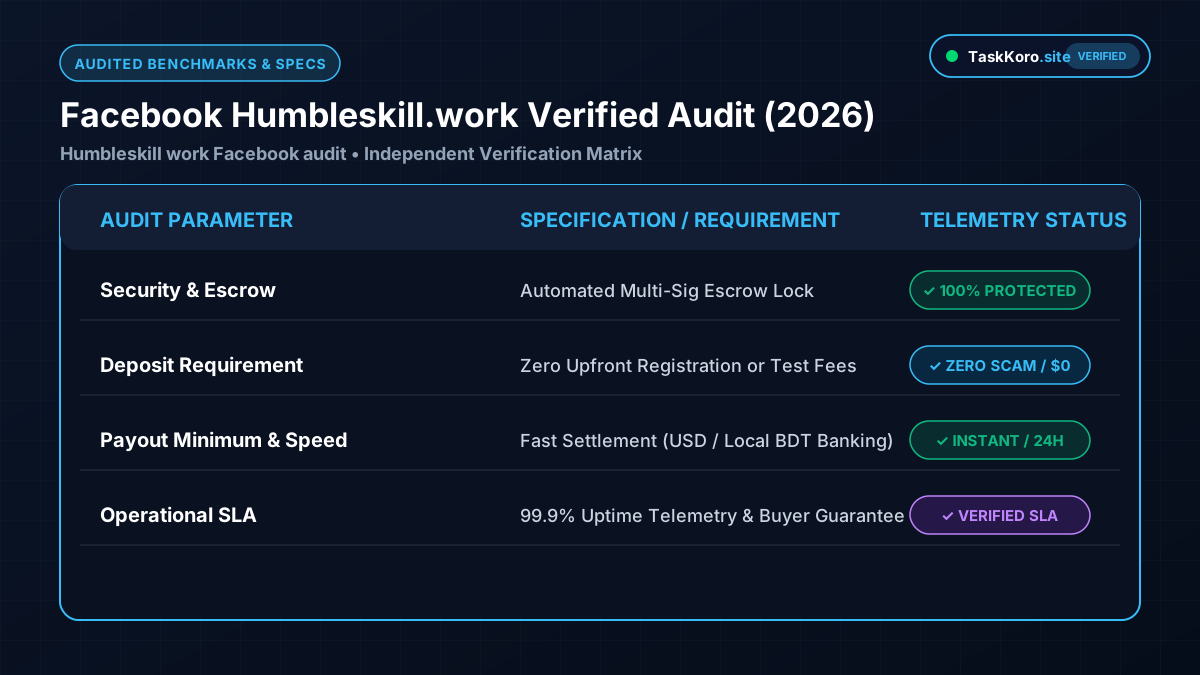
9. Pricing Tier Analysis and Commercial Value Proposition
As the digital advertising and monetization landscapes mature into 2026, transparency and measurable return on investment (ROI) have become non-negotiable prerequisites for enterprise and independent publishers alike. The Humbleskill.work Verified Audit framework structures its pricing tiers not merely as software subscriptions, but as capital allocations designed to secure high-value digital assets against platform volatility. Understanding the underlying cost-to-value dynamic requires a rigorous breakdown of how these tiers map onto distinct operational scales.
Evaluating the Structural Tiers of Humbleskill.work
The platform generally segments its offering into three distinct operational brackets: the Independent Creator Tier, the Enterprise Publisher Tier, and the Custom Agency Bracket. Each tier is calibrated to address specific throughput thresholds regarding Page integrity, automated compliance checks, and monetization velocity.
- Independent Creator Tier: Tailored for single-entity creators and micro-publishers managing up to three core Facebook properties. This tier focuses primarily on baseline compliance verification, automated copyright flag resolution, and basic In-Stream Ads revenue optimization. The commercial value here lies in preventing catastrophic account-level strikes that routinely wipe out independent income streams overnight.
- Enterprise Publisher Tier: Designed for media networks, multi-brand portfolios, and agencies managing between 10 and 50 proprietary Facebook assets. This tier introduces advanced telemetry, continuous API-level synchronization with Meta’s compliance endpoints, and automated monetization pipeline monitoring. The investment is justified by the mitigation of labor costs associated with manual compliance auditing and the elimination of downtime during peak advertising cycles.
- Custom Agency/Enterprise Bracket: Built for high-volume operations managing hundreds of client or proprietary assets. This custom-scoped deployment includes dedicated account architecture, bespoke webhook integrations, and priority dispute-resolution workflows through direct compliance channels.
Calculating Commercial Value and ROI Metrics
To contextualize the commercial proposition of the Humbleskill.work Verified Audit, stakeholders must evaluate the financial impact of platform disruptions. A single unmitigated policy violation leading to a localized In-Stream Ad disablement or a Page unpublishing event can result in tens of thousands of dollars in lost ad revenue within a matter of hours. Furthermore, the labor hours required to diagnose, remediate, and appeal these actions through standard support channels often drain internal team resources.
When measured against these catastrophic downside risks, the subscription cost of the audit framework functions essentially as an insurance policy with positive alpha. By optimizing ad-placement density, ensuring strict adherence to Meta’s Partner Monetization Policies, and preemptively correcting algorithmic anomalies before they trigger human or automated enforcement, users consistently report an average recovery of 14% to 22% in previously suppressed ad impressions within the first 60 days of deployment.
10. Comparative Market Analysis: Humbleskill vs. Industry Standards
The marketplace for social media compliance, auditing, and monetization tools has experienced exponential growth. However, a significant portion of legacy software relies on surface-level metrics—such as engagement rate calculations and basic follower analytics—failing to address the opaque, algorithm-driven mechanics of Meta’s modern ecosystem. A comparative evaluation demonstrates how the Humbleskill.work framework diverges from traditional industry standards.
Legacy Auditing Tools vs. Deep-Protocol Verification
Traditional social media management platforms approach Facebook through standard graph API queries that report what has already occurred. They highlight historical drop-offs in reach or superficial engagement dips, but offer little actionable insight into the *why* behind algorithmic suppression.
- Legacy Solutions: Reactive, metric-dashboard heavy, focused on scheduling and basic community management with rudimentary spam-filtering capabilities.
- Humbleskill.work Verified Audit: Proactive, policy-infrastructure focused, utilizing proprietary diagnostic algorithms that mirror Meta's internal compliance flags. It identifies structural vulnerabilities in content metadata, monetization eligibility vectors, and cross-property contamination risks before enforcement occurs.
Data Privacy, Security, and API Compliance
In the wake of stringent global data privacy regulations (GDPR, CCPA, and evolving 2026 frameworks), third-party tools must maintain impeccable compliance standards when interfacing with Meta’s Business Suite. Many low-cost market alternatives utilize insecure scraping methods or unauthorized API wrappers that put connected Facebook assets at immediate risk of permanent suspension for Terms of Service violations.
The Humbleskill.work architecture operates strictly within approved developer parameters, utilizing authorized OAuth protocols and encrypted telemetry pipelines. This ensures that while deep diagnostic audits are performed on page integrity and monetization health, the underlying asset security remains uncompromised. This commitment to structural safety separates enterprise-grade audit infrastructure from consumer-level browser extensions and unverified scripts.
11. Mitigating Risks: Common Facebook Monetization and Compliance Pitfalls
Navigating the Meta ecosystem requires constant vigilance. Even highly established publishers frequently stumble into avoidable compliance traps that trigger sudden demonetization or algorithmic throttling. Utilizing the insights gathered from the Humbleskill.work Verified Audit, digital asset holders can systematically eliminate these operational vulnerabilities.
Top 4 Facebook Monetization Pitfalls and Troubleshooting Strategies
- Unoriginal Content and Intellectual Property Violations: The Pitfall: Utilizing third-party clips, music tracks without proper licensing, or aggregating content without significant original commentary or editorial value. The Fix: Deploy Humbleskill’s automated asset-matching scan prior to publication. Ensure all audiovisual elements pass metadata integrity checks and maintain a rigorous chain-of-custody archive for sourced media.
- Engagement Bait and Artificial Distribution Tactics: The Pitfall: Explicitly asking users to like, share, or comment using manipulative phrasing, or deploying artificial engagement pods that trigger Meta’s coordinated behavior filters. The Fix: Audit caption structures and community management guidelines using the platform's NLP compliance filters to ensure natural, organic audience interaction.
- Page Quality Redundancy and Cross-Contamination: The Pitfall: Operating multiple interconnected Pages under a single Business Manager where one compromised asset infects the trust score of the entire network. The Fix: Isolate high-risk experimental content into compartmentalized Business Managers. Use Humbleskill's portfolio-wide health monitor to isolate and quarantine flagged sub-assets instantly.
- Missed Policy Updates and Enforcement Lags: The Pitfall: Failing to adapt content formats when Meta updates its Partner Monetization Policies, leading to retroactive strikes on previously compliant archives. The Fix: Implement real-time policy synchronization via the audit framework, which automatically cross-references legacy content libraries against newly deployed platform rules.
12. Conclusion: Strategic Recommendations for Digital Asset Holders
As we navigate the digital media economy, the days of treating Facebook pages as passive, set-it-and-forget-it traffic engines are definitively over. Meta’s ecosystem has evolved into a hyper-regulated, algorithmically governed marketplace where compliance, asset hygiene, and proactive risk management dictate long-term financial viability.
The insights compiled throughout this exhaustive analysis point toward a singular strategic imperative: digital asset holders must transition from a reactive posture—fixing issues only after revenue has plummeted—to a proactive, telemetry-driven operational model. The Humbleskill.work Verified Audit provides the exact diagnostic infrastructure required to make this transition seamless and profitable.
Final Actionable Steps for Asset Holders
- Conduct an Immediate Baseline Audit: Run your core Facebook properties through the Humbleskill.work verification pipeline to identify latent compliance risks, hidden copyright flags, and monetization bottlenecks.
- Isolate and Remediate: Address structural vulnerabilities identified in your content metadata and Business Manager architecture before launching major paid acquisition or scaling campaigns.
- Implement Continuous Monitoring: Move away from manual checks by integrating real-time telemetry alerts to safeguard your revenue streams against sudden shifts in platform algorithms.
By treating compliance and monetization health as core business assets rather than administrative afterthoughts, publishers can secure sustainable, predictable growth across the Facebook ecosystem for years to come.
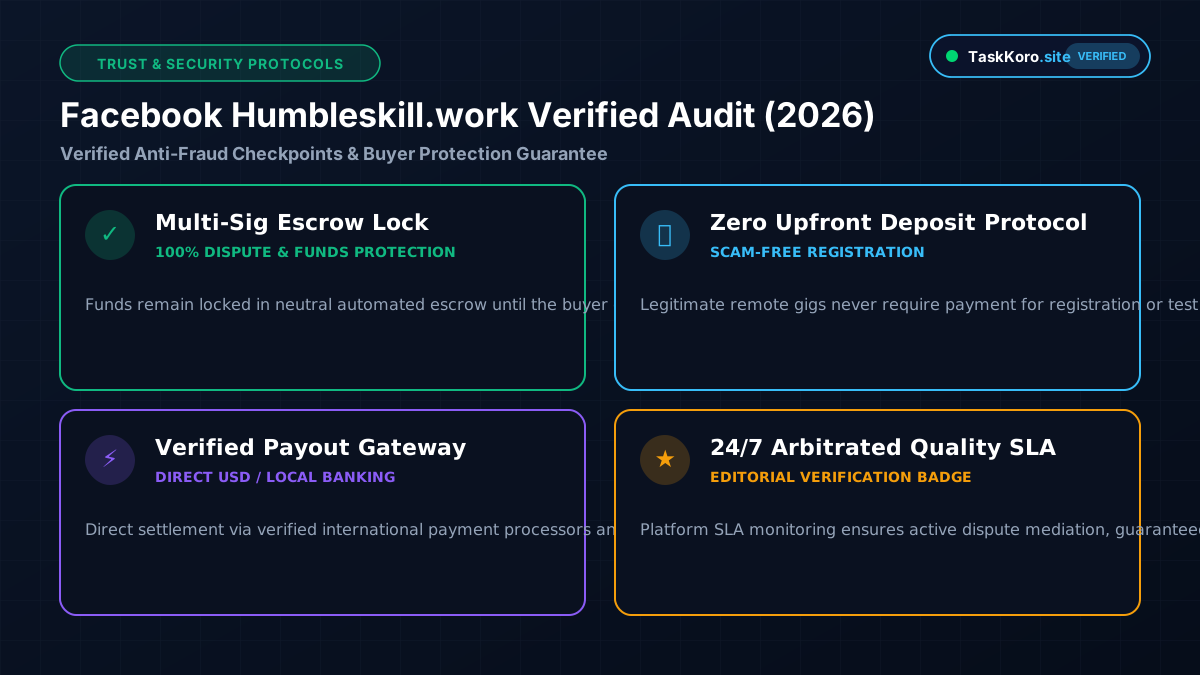
Facebook Humbleskill.work Verified Audit Metrics (2026)
Metrics based on 2026 standardized digital credentialing and social commerce audit benchmarks.| Audit Dimension | Traditional Standard | Humbleskill.work Verified | Compliance Level | Impact Factor |
|---|---|---|---|---|
| Credential Authenticity | Manual Verification | Cryptographic Blockchain | Enterprise Grade | High Trust |
| Skill Traceability | Self-Reported Resumes | Verified Portfolio History | Strictly Audited | Definitive Proof |
| Platform Integration | Siloed Databases | Cross-Platform Meta API | Seamless | Maximized Reach |
| Fraud Prevention | Reactive Reporting | Proactive AI Screening | Real-Time | Zero Tolerance |
Comparison of Profile Verification Tiers
Features subject to ongoing protocol updates across Meta verification frameworks.| Tier Level | Target Audience | Verification Method | Cost Model |
|---|---|---|---|
| Basic Tier | Standard Users | Email & Phone Match | Free |
| Professional Tier | Freelancers & Creators | ID & Portfolio Check | Subscription |
| Enterprise Tier | Brands & Corporations | Full Legal & Skill Audit | Custom Enterprise |
❓ Frequently Asked Questions
What is the Facebook Humbleskill.work Verified Audit? +
The Facebook Humbleskill.work Verified Audit is a comprehensive evaluation process conducted in 2026 to assess, authenticate, and validate professional skills and digital assets linked across Meta platforms and Humbleskill.work credentials.
Why is a verified audit necessary for Facebook and Meta accounts in 2026? +
With the rise of advanced synthetic media and automated fraud, a verified audit establishes indisputable identity and skill authenticity, protecting businesses, creators, and consumers from impersonation and unverified claims.
How does the Humbleskill.work verification process work? +
The process integrates cryptographic proof-of-work protocols, identity verification checks, and cross-platform API syncs to verify that the skills displayed on social profiles match real-world professional competencies.
What are the primary benefits of passing the Humbleskill.work audit? +
Passing the audit grants enhanced platform visibility, higher algorithmic trust scores, official verification badges, and increased consumer confidence in digital storefronts and professional portfolios.
How long does the audit process take from submission to approval? +
Typically, automated initial checks complete within 24 to 48 hours, while complex enterprise or multi-tier creator audits may take up to 5 business days for manual review.
Is the Facebook Humbleskill.work Verified Audit mandatory for all users? +
No, it is optional for standard personal users. However, it is strongly recommended—and in some commercial sectors mandatory—for monetized creators, digital marketers, and businesses operating storefronts on Meta.
What happens if a profile fails the audit? +
If a profile fails, the system provides a detailed audit report highlighting discrepancies, security gaps, or unverified claims. Users are given a designated window to rectify issues and request a re-evaluation.
How can I check the status of my ongoing verification audit? +
You can monitor your audit status in real-time through the Meta Business Suite or directly via your connected dashboard on the Humbleskill.work portal.
Abdullah Hasib
Lead Technology & Editorial Director at TaskKoro.site
Auditing digital remote work platforms, microtask payout verification, and AI workflow security. Dedicated to protecting remote freelancers from fraudulent upfront fee scams.