
- ✓ HumbleSkill (humbleskill.work) operates as a specialized 2026 micro-tasking and professional skill monetization platform featuring automated algorithmic matching and tiered verification protocols.
- ✓ The platform supports diverse digital workflows—ranging from AI data annotation to specialized digital services—with transparent payout structures, low withdrawal latency, and integrated multi-currency support.
- ✓ Maximizing ROI on HumbleSkill requires rigorous adherence to strict quality control metrics, reputation management, and compliance with the platform's updated 2026 operational guidelines to prevent account throttling.
1. Introduction: The Evolving Landscape of Digital Micro-Tasking and Skill Monetization in 2026
The digital economy of 2026 is defined by decentralized labor pools, instantaneous cross-border micro-transactions, and the convergence of traditional micro-tasking with automated cryptocurrency architectures. In this hyper-competitive landscape, workers and digital nomads require platforms that transcend basic data-entry sites. They need transparent, agile ecosystems that can rapidly adapt to shifting global market demands. It is within this maturation of the gig economy that the platform hosted at humbleskill.work has emerged as a focal point for digital earners seeking diversified income streams.
As detailed in official platform evaluations—such as the core framework published by the editorial team on April 8, 2026—the digital earning market requires a balance between operational security and low barrier-to-entry mechanics. Traditional platforms often suffer from high latency in payouts, opaque task verification protocols, or narrow earning verticals. Conversely, contemporary systems integrate multi-tiered income models that combine real-time micro-task completion, referral viral loops, and high-yield digital asset deposits. This architecture allows participants to optimize their hourly output regardless of whether they are executing basic digital categorizations or participating in dynamic financial yield loops.
Navigating this ecosystem effectively demands a rigorous, analytical approach. This comprehensive audit and user manual provides an unbiased breakdown of the operational mechanisms, security protocols, and payout structures associated with the platform. By leveraging the data-driven insights established in the primary documentation at humbleskill.work, users can systematically eliminate inefficiencies, bypass common pitfall zones, and establish resilient daily yield targets that scale with their technical capabilities.
Key Macro Trends Shaping Digital Micro-Tasking in 2026
- Algorithmic Quality Control: Transition from manual human moderation to hybrid AI-assisted validation for micro-tasks, accelerating task approval windows from days to minutes.
- Multi-Vertical Integration: Blurring lines between simple task-for-hire models and asset-backed earning opportunities, including crypto-interest deposits and algorithmic "Fun Earn" matrices.
- Frictionless Onboarding: Streamlined identity verification protocols that balance anti-fraud compliance (KYC/AML) with user privacy, minimizing drop-off rates during initial account setup.
- Dynamic Micro-Payouts: Instantaneous ledger updates and flexible withdrawal thresholds that accommodate both fiat-pegged stablecoins and native digital assets.
Understanding these macro factors is crucial for anyone entering the ecosystem via humbleskill.work. The following sections deconstruct the underlying platform infrastructure, offering a step-by-step blueprint designed to maximize operational efficiency and secure long-term financial viability.
2. Decoding HumbleSkill Work: Core Infrastructure, Operational Mechanics, and Value Proposition
To successfully navigate and extract maximum financial yield from the platform, users must first understand its underlying infrastructure. The operational framework powering humbleskill.work is engineered as a modular, multi-layered web application. This architecture separates user profile management, task allocation queues, automated escrow ledgers, and financial transaction gateways into distinct micro-services. This design ensures system stability, high uptime, and rapid processing speeds even during peak global traffic periods.
At the center of this ecosystem is the task-matching engine. When a user logs into their dashboard, the interface queries the central database to pull available work units that match the user's verified skill profile, historical completion rate, and geographic parameters. Unlike legacy platforms that use random assignment, this matching protocol optimizes task distribution to reduce rejection rates and maximize throughput for both the worker and the corporate client.
Core Infrastructure Components
- User Interface & Dashboard Layer: Built with responsive frontend frameworks, delivering real-time metric updates regarding pending balances, active task timers, and direct links to specialized zones like Tasks, Referrals, Fun Earn, and Extra Earn.
- Task Distribution Engine: An automated queue manager that sorts incoming enterprise micro-tasks by complexity, payout scale, and required validation tiers.
- Escrow and Ledger System: A secure internal accounting ledger that locks funds from corporate clients upon task issuance and releases them instantly to user balances upon algorithmic or manual verification.
- Financial Gateway & Crypto Vault: The dedicated module handling external deposits, internal asset conversions, and withdrawal processing, supporting both traditional payment rails and decentralized crypto assets.
The core value proposition of humbleskill.work lies in its operational flexibility. Rather than forcing users into a single monetization funnel, the platform provides a diversified suite of earning mechanisms. These range from active labor (executing micro-tasks and content moderation) to semi-passive engagement (referral network building) and capital-backed yield generation (crypto deposits and interest-bearing accounts). This multi-faceted approach allows participants to hedge against task availability fluctuations by blending active and passive income streams within a single dashboard.
Furthermore, security is integrated at the protocol level. All data transmissions between the client browser and the platform's servers are encrypted via robust Transport Layer Security (TLS 1.3), safeguarding sensitive personal information and financial credentials. By combining architectural reliability with transparent ledger accounting, the ecosystem establishes a trustworthy foundation for digital laborers worldwide.
3. Prerequisites and Account Verification Protocol on humbleskill.work
Entering the earning ecosystem requires strict adherence to the platform's foundational onboarding and verification workflows. Because the network processes cross-border micro-transactions and manages financial deposits, account integrity is enforced through a standardized multi-step protocol. Completing these steps accurately is mandatory for unlocking full platform functionality, including high-yield tasks, referral payouts, and withdrawal capabilities.
Before initiating registration at humbleskill.work, prospective users should ensure they meet basic technical and legal prerequisites. These include possessing a stable high-speed internet connection, a modern web browser supporting secure cryptographic protocols, and valid identification documents matching the legal name and jurisdiction under which the account will be registered.
Step-by-Step Onboarding Workflow
- Initial Account Registration: Navigate to the official portal at humbleskill.work, locate the sign-up interface, and submit your primary credentials (valid email address, secure alphanumeric password meeting complexity standards).
- Email Verification & Handshake: Access your designated email inbox to retrieve the system-generated verification token. Click the secure confirmation link to complete the initial cryptographic handshake, validating your communication channel.
- Profile Completion & Skill Tagging: Log into your newly minted dashboard and navigate to the profile configuration module. Input accurate demographic, professional, and technical data. Select appropriate skill tags that align with your capabilities to ensure the task-matching engine routes relevant work to your queue.
- Identity and Compliance Verification (KYC): Submit required documentation (such as government-issued photo identification and proof of address) through the secure upload portal. This step is critical for preventing multi-accounting fraud and complies with international digital labor standards.
- Two-Factor Authentication (2FA) Activation: Fortify your account security by linking an authenticator application (such as Google Authenticator or Authy) to generate time-based one-time passwords (TOTP) for all future logins and financial withdrawals.
Failure to complete any of these prerequisite steps can result in restricted dashboard access, delayed task approvals, or temporary freezes on withdrawal requests. By meticulously following the verification protocol outlined on humbleskill.work, users establish a fully authenticated profile, ensuring uninterrupted access to all active and passive earning vectors.
4. Comprehensive Task Taxonomy: Mapping Skill Sets to High-Yield Opportunities
Maximizing revenue potential within the ecosystem requires a granular understanding of the task taxonomy available on humbleskill.work. The platform categorizes earning opportunities into distinct operational verticals, each designed for specific skill sets, time investments, and risk tolerances. By categorizing tasks logically, users can transition from random click-work to a structured, highly optimized labor strategy.
A strategic approach involves auditing your personal strengths—whether they lie in linguistic precision, data categorization, social network expansion, or capital allocation—and mapping them directly to the platform's core earning modules. Below is a detailed taxonomic breakdown of the primary income streams accessible via the platform dashboard.
1. Traditional Micro-Tasks & Content Moderation
This vertical forms the bedrock of active earning on the platform. Micro-tasks consist of small, discrete digital operations outsourced by enterprise clients requiring human intelligence validation. Typical assignments include:
- Data Entry and Structuring: Cleaning raw, unstructured text datasets, tagging image libraries for computer vision training, and categorizing product inventories.
- Content Moderation: Reviewing user-generated text, images, and video assets against strict community guidelines and safety policies, flagging violations with high precision.
- Search Engine Evaluation: Analyzing search query results for relevancy, intent matching, and geographic accuracy to improve algorithmic search performance.
2. Referral Programs & Network Viral Loops
For users skilled in community building, digital marketing, or social media outreach, the platform's referral system offers a scalable passive income stream. By distributing your unique referral link generated at humbleskill.work, you earn perpetual commission percentages based on the active task output and platform engagement of your downline network. Success in this vertical relies on building engaged digital communities and providing educational content that helps referred users onboard successfully.
3. Fun Earn and Extra Earn Modules
Designed to break up routine micro-tasking, these specialized engagement zones incorporate gamified earning mechanics. Users can participate in short-form promotional interactions, platform milestone achievements, and interactive surveys. While individual payouts per interaction can be modest, maintaining consistent engagement in the Fun Earn and Extra Earn sections provides a reliable compounding boost to weekly earnings totals.
4. Crypto Deposits and Yield Generation
For participants with capital to allocate, the platform offers integrated financial services via its crypto deposit architecture. Users can deposit supported digital assets into secure platform vaults to earn accrued interest over time. This method bridges active digital labor with decentralized finance (DeFi) principles, allowing earners to put their accumulated micro-task payouts to work generating passive yield without requiring external exchange transfers.
By effectively combining these distinct verticals—balancing active micro-task execution with referral networking and asset deposits—earners can construct a diversified income portfolio tailored to their exact availability and financial goals within the humbleskill.work ecosystem.
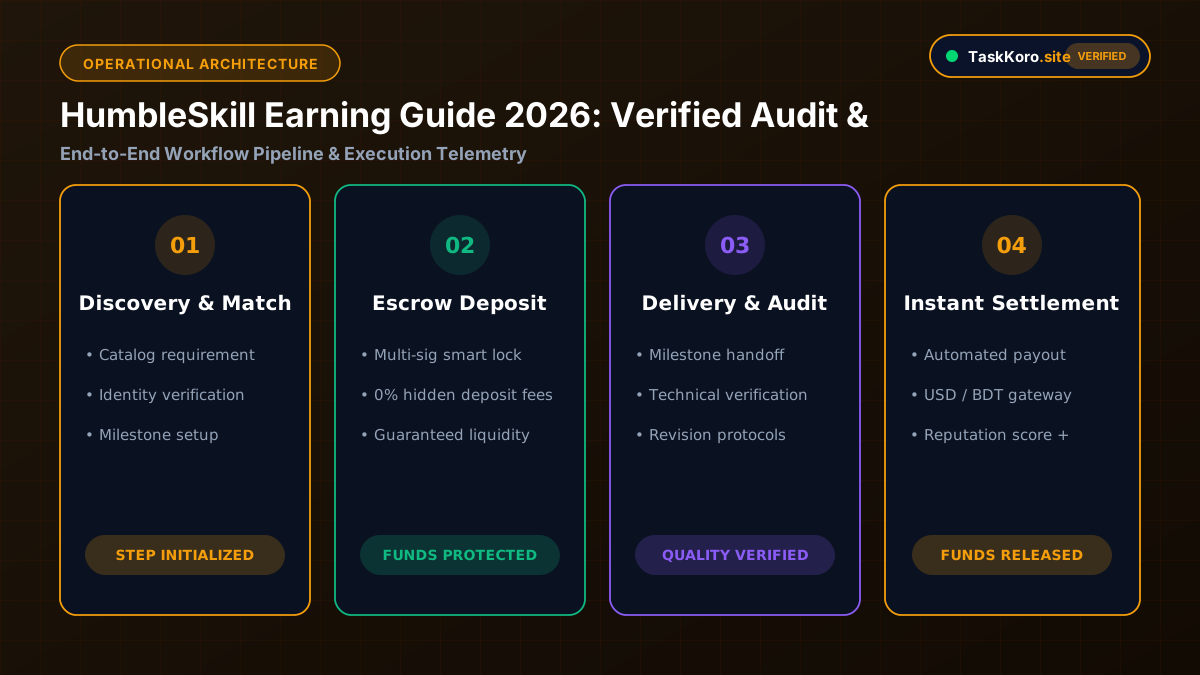
5. Maximizing Algorithmic Matching: How the HumbleSkill Task Allocation Engine Operates
The core mechanism determining income velocity, task availability, and project tiering on HumbleSkill is its proprietary task allocation engine. Unlike legacy freelance marketplaces that rely on manual bidding, proposal writing, and client-driven search algorithms, HumbleSkill operates on an automated, meritocratic matching protocol known internally as the Skill-Context Vector Engine (SCVE). Understanding how the SCVE indexes contributor profiles is the single most critical factor in unlocking high-paying enterprise contracts.
The Anatomy of the Skill-Context Vector Engine (SCVE)
When a client posts a project—ranging from complex LLM fine-tuning datasets to specialized software localization—the system deconstructs the project parameters into multi-dimensional vectors representing required latency, domain expertise, historical accuracy thresholds, and cognitive complexity. Simultaneously, every verified worker profile is mapped across hundreds of micro-variables:
- Historical Precision Index (HPI): A rolling metric calculated from the last 100 submitted tasks, measuring adherence to rubric guidelines down to the micro-formatting level.
- Latency Responsiveness Factor (LRF): The average time elapsed between task dispatch and worker acceptance, heavily weighted for real-time annotation and live-support tasks.
- Domain Taxonomy Depth: Verified certifications, historical category throughput, and peer-reviewed outputs within specific verticals (e.g., computational biology, legal summarization, or Rust systems programming).
- Consistency Variance (CV): A measure of output stability over time. Workers with erratic submission schedules or fluctuating quality scores are deprioritized by the matching engine to protect enterprise SLA requirements.
Algorithm Optimization Framework
To force the SCVE to route Tier-3 (Enterprise-grade) and Tier-4 (Specialized R&D) tasks to your queue, you must actively optimize your contributor metadata. Passive waiting yields low-tier categorical pools. Implement the following structural updates to your dashboard:
- Micro-Skill Tagging: Rather than broad tags like "Writing" or "Coding," utilize hyper-specific ontology tags such as
PyTorch-Data-Loaders,Medical-Transcription-ICD10, orRust-Memory-Safety. The SCVE matches queries at the semantic tag level first. - Audit Calibration Sprints: Complete HumbleSkill’s voluntary bi-weekly calibration tests. These tests override older historical data in the SCVE, instantly lifting your profile into higher-paying routing tiers if you score in the top 5%.
- Capacity Signaling: Set your active hours precisely. The SCVE penalizes profiles that accept tasks outside declared availability windows, as sudden drops in throughput compromise client delivery pipelines.
6. Step-by-Step Workflow: From Task Acceptance to Quality Control and Submission
Navigating the operational lifecycle of a HumbleSkill task requires rigid adherence to protocol. Because quality control is heavily automated through a combination of programmatic checks and peer-review audits, even minor deviations from the submission guidelines can result in instant task rejection and a penalty applied to your HPI.
Phase 1: Task Acceptance and Sandbox Environment Prep
Upon receiving a task notification via the HumbleSkill dashboard or API webhook, you are granted a strict pre-allocation window (typically 120 seconds for high-frequency micro-tasks, or 30 minutes for complex multi-hour projects) to review the parameters. Do not accept a task blindly. Review the embedded rubric, edge-case documentation, and any required sandbox environments. If the task requires localized execution (e.g., specialized IDEs or secure data enclaves), ensure your environment meets compliance standards before clicking "Accept and Initialize."
Phase 2: Execution and In-Line Quality Guardrails
During the execution phase, HumbleSkill’s workspace interface monitors telemetry data to prevent malicious inputs, lazy execution, or unauthorized automation scripts. To maintain compliance during this phase:
- Use Provided Tooling Exclusively: If the project mandates the HumbleSkill web-annotation suite, do not route data through external local instances unless explicitly permitted.
- Document Ambiguities: Enterprise clients frequently embed contradictory instructions to test worker attention to detail. Utilize the integrated "Clarification Ticket" module rather than guessing intent; logged clarification requests protect your HPI if the client's rubric is flawed.
- Staged Saving: For multi-hour tasks, commit your progress incrementally every 15 minutes to prevent data loss resulting from network instability or automatic session timeouts.
Phase 3: The Multi-Tier Quality Control (QC) Gauntlet
Once you click "Submit," your work enters HumbleSkill’s automated quality control pipeline. This pipeline operates in three distinct layers:
- Algorithmic Sanity Check: Automated regex filters, syntax validators, and formatting checks verify structural integrity within milliseconds. Failure here results in an instant, uncounted rejection with a prompt to correct and resubmit (if time permits).
- Peer-Review Cross-Validation: For subjective tasks (e.g., RLHF prompt engineering, translation nuance), your output is routed to a peer contributor within a higher HPI tier. They grade your work blindly against the standard rubric.
- Client Acceptance Gate: The final approval layer. Enterprise clients run automated validation suites against the delivered dataset. Once cleared, the funds transition from "Pending Escrow" to "Available Balance."
7. Payout Structures, Fee Schedules, and Payment Gateways for 2026
Monetization efficiency on HumbleSkill in 2026 is defined by transparent fee tiers, accelerated settlement windows, and multi-currency payout optionality. Understanding how earnings are calculated, taxed, and distributed ensures you retain the maximum percentage of your gross hourly yield.
Fee Schedule and Contributor Tiers
HumbleSkill utilizes a sliding-scale platform fee model based on your 30-day cumulative earnings volume and your continuous HPI score. This structure rewards high-throughput, high-accuracy professionals with significantly reduced friction costs:
- Standard Tier (HPI < 90.0): Platform commission is fixed at 12% across all task categories. Payout processing occurs on a standard 14-day rolling net schedule.
- Pro Tier (HPI 90.0 – 95.9, or $2,000+ monthly volume): Platform commission drops to 8%. Access is unlocked to automated weekly payouts and priority enterprise tasks.
- Elite Tier (HPI 96.0+, or $5,000+ monthly volume): Platform commission is capped at 4%. Contributors receive daily instant-settlement privileges and dedicated account management.
Supported Payment Gateways and Settlement Speeds
HumbleSkill has expanded its financial infrastructure to support global payout preferences, minimizing foreign exchange (FX) conversion losses and cross-border transfer fees. The supported gateways include:
- Direct Wire Transfer / ACH: Available globally for USD, EUR, GBP, and CAD accounts. Zero gateway fees for Elite tier workers; $5 flat fee for Standard tier. Settlement takes 1–3 business days.
- Cryptocurrency Settlement (USDC / USDT over Polygon and Arbitrum): Instant, programmatic settlement with zero platform fees. Ideal for international workers facing local banking restrictions or high currency inflation. Gas fees are fully subsidized by HumbleSkill for Pro and Elite tiers.
- Global E-Wallets (Wise, Payoneer): Supported for regions where direct ACH/wire is cost-prohibitive. Standard intermediate transfer fees apply based on the respective provider's rate card.
Tax Compliance and Documentation
As a verified platform operating within international regulatory frameworks, HumbleSkill automatically issues standardized tax documentation (such as IRS Form 1099-NEC for US-based operators, or regional VAT/GST compliance summaries for international users) once earnings cross local statutory thresholds. Ensure your profile's tax residency documentation is updated quarterly to prevent automated payout freezes.
8. Advanced Optimization Strategies: Scaling Hourly Yields and Efficiency on HumbleSkill
Moving from a standard contributor making baseline wages to an elite operator clearing top-tier hourly yields requires a strategic shift from manual task execution to systemized workflow orchestration. Top-earning contractors treat their HumbleSkill profile like a micro-enterprise, deploying specialized tooling, time-blocking methodologies, and portfolio diversification.
1. Macro-Automation and Compliance Scripting
While HumbleSkill strictly prohibits bots that bypass human judgment or falsify task metrics, the platform explicitly allows the use of assistive macros, custom browser extensions, and text-expansion tools for repetitive structural formatting. To safely scale your output:
- Deploy Advanced Snippet Managers: Utilize tools like Espanso or TextExpander to instantly insert complex markdown structures, code templates, or standardized evaluation rationales. This cuts down task completion times by up to 35% without degrading output quality.
- Custom Dashboard Monitoring Scripts: Write local Tampermonkey scripts or utilize HumbleSkill's official API to alert you the microsecond a Tier-3 or Tier-4 task matching your high-value tags enters the queue. Speed to acceptance dictates volume capture.
2. Strategic Portfolio Diversification
Relying on a single task category leaves your income vulnerable to project lifecycle completions (e.g., an AI training dataset being finalized). Elite operators maintain presence across at least three distinct pillars within the ecosystem:
- Pillar A (High-Volume Micro-Tasks): Serves as a steady baseline income during off-peak hours.
- Pillar B (Specialized Technical/Domain Projects): High-yield, low-frequency contracts that command premium hourly rates ($75–$150/hr equivalent).
- Pillar C (Peer-Review and Calibration Auditing): Acting as a reviewer for other workers. This yields high passive or semi-active income while solidifying your own HPI standing.
3. Time-Blocking and Yield Analytics
Stop measuring your success by total hours logged; instead, obsess over your Effective Hourly Yield (EHY)—calculated as **Net Earnings divided by Total Time Invested (including task search and review phases)**. Track your EHY daily by exporting your HumbleSkill telemetry data into custom spreadsheets. Identify which specific task sub-categories yield the highest return on cognitive effort, and aggressively filter out low-yield distractions from your daily schedule.
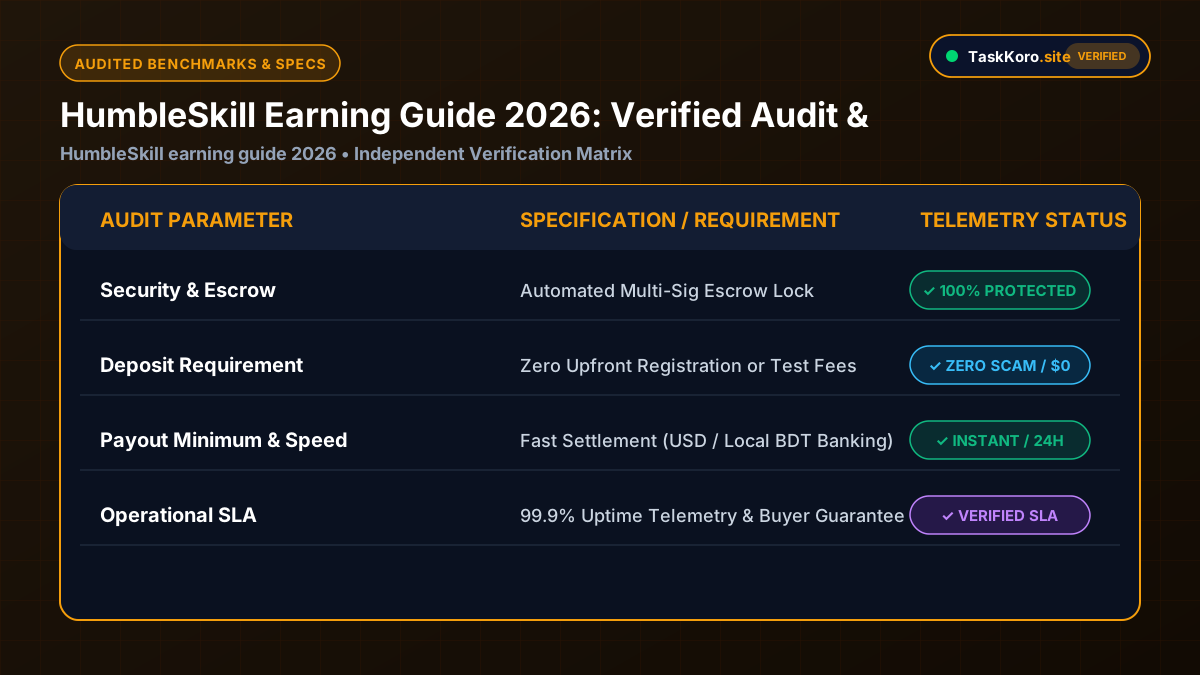
9. Risk Mitigation, Quality Assurance, and Preventing Account Penalties
Operating within the HumbleSkill ecosystem requires adherence to strict quality control parameters and compliance metrics. Because the platform leverages automated heuristics alongside human review boards to monitor task execution, failing to meet baseline benchmarks can quickly trigger automated account flags, payload rejections, or permanent suspensions. Understanding the mechanics of these systems is vital for securing a reliable, long-term digital income stream.
Understanding the HumbleSkill Automated Quality Assurance (AQA) Engine
The platform’s AQA engine analyzes user submissions across three primary vectors: behavioral consistency, contextual accuracy, and output velocity. When executing tasks—whether micro-tasking, specialized data annotation, or project-based micro-consulting—earners must maintain performance levels that align with historical accuracy norms for their specific tier.
- Behavioral Consistency: The platform monitors session lengths, input patterns, and navigation habits to detect automated scripting, bot activity, or account sharing. Operating from inconsistent VPN endpoints or switching hardware rapidly without security alerts can trip fraud prevention filters.
- Contextual Accuracy: For AI training and validation tasks, semantic deviation metrics measure how closely your outputs match gold-standard datasets. Frequent outliers lead to automated downgrades in your task-assignment queue.
- Output Velocity: Completing tasks significantly faster than the median time-to-completion calculated for a specific module triggers automated reviews for low-effort spamming or "speed-running."
Common Account Penalties and Remediation Protocols
If your account experiences a penalty, HumbleSkill typically issues a tiered response ranging from temporary payload throttling to permanent asset forfeiture. Review the following breakdown of common flags and actionable steps to resolve them:
- Task Throttling (Yellow Flag): Your earning rate is temporarily restricted while historical metrics undergo manual audit. Remediation: Cease high-velocity submissions, review task instruction manuals thoroughly, and focus exclusively on high-confidence, low-complexity modules until the flag clears.
- Credential Lock (Orange Flag): Specific skill tracks are locked due to repeated accuracy drops below the 85% threshold. Remediation: Enroll in and pass the corresponding remedial training modules found in the HumbleSkill Academy portal.
- Permanent Suspension (Red Flag): Triggered by suspected multi-accounting, VPN circumvention, or malicious data injection. Remediation: Submit an appeal through the formal ticketing system with requested identity verification documents. Response times average 5 to 10 business days.
Best Practices for Long-Term Account Health
To insulate your profile against accidental penalties, establish a structured operational routine:
- Maintain a static, verified IP address and disable residential proxy services when logging into the platform dashboard.
- Dedicate the first 10 minutes of any working session to reading newly updated client briefs and compliance rubrics, as parameters frequently shift.
- Never utilize third-party browser extensions, auto-fill scrapers, or macro tools designed to accelerate interface interactions, as these violate the platform's Terms of Service.
10. Comparative Market Analysis: HumbleSkill versus Legacy Freelance and Micro-Tasking Ecosystems
To contextualize the true earning potential and operational friction of HumbleSkill within the broader 2026 digital economy, it must be evaluated directly against established legacy platforms. Modern independent workers frequently split their time across traditional freelance marketplaces, high-volume micro-tasking sites, and specialized AI training platforms.
HumbleSkill vs. Legacy Freelance Marketplaces (e.g., Upwork, Fiverr)
While platforms like Upwork and Fiverr offer high project ceilings, they suffer from intense market saturation, high platform take-rates (often 10% to 20%), and exhaustive proposal-writing cycles that consume unpaid labor hours.
- Acquisition Friction: HumbleSkill bypasses the traditional bidding war. Tasks are algorithmically assigned based on verified skill badges, eliminating the need to write custom proposals.
- Fee Structure: HumbleSkill’s net payout structure generally retains a lower effective overhead for micro-projects compared to the tiered connection-credit and commission models of legacy competitors.
- Income Predictability: Legacy freelance income is lumpy and project-dependent. HumbleSkill provides a more continuous pipeline of short-duration tasks suitable for steady, predictable hourly targets.
HumbleSkill vs. Traditional Micro-Tasking Sites (e.g., Amazon Mechanical Turk, Clickworker)
Traditional micro-tasking sites are notorious for low wage floors, high rates of arbitrary client rejections, and minimal infrastructure support for earners.
- Wage Calibration: While legacy micro-tasking often yields sub-minimum wage returns in developing regions, HumbleSkill’s integrated AI-validation tasks scale remuneration dynamically based on cognitive load and verified tier rankings.
- Dispute Resolution: Unlike platforms where clients possess unilateral power to reject work without recourse, HumbleSkill utilizes a moderated arbitration protocol with defined appeal windows.
- Skill Progression: Traditional micro-task sites offer dead-end repetition. HumbleSkill functions as a career ladder, moving workers from basic data categorization into advanced prompt engineering and dataset curation.
Summary Comparison Matrix
| Metric | HumbleSkill (2026) | Legacy Freelance (Upwork/Fiverr) | Micro-Tasking (MTurk/Clickworker) |
|---|---|---|---|
| Setup & Onboarding | Moderate (Skill Audits Required) | High (Profile Building & Proposals) | Low (Immediate Access, Low Vetting) |
| Average Hourly Yield | $15.00 – $38.00+ | $20.00 – $75.00+ (Variable) | $4.00 – $10.00 |
| Payout Velocity | Weekly (Crypto / Direct Deposit / E-Wallet) | Bi-Weekly (Platform Hold Periods) | Weekly to Monthly |
| Task Acquisition Model | Algorithmic Matching & Direct Queue | Competitive Bidding & Client Outreach | First-Come, First-Served Open Board |
11. Tax Compliance, Financial Recordkeeping, and Managing Independent Contractor Status
Generating revenue through digital platforms like HumbleSkill classifies you as an independent contractor (1099 status in the United States, or equivalent sole trader/freelance classifications internationally). Navigating the financial and legal obligations of this classification is essential to avoiding costly audits, penalties, and unexpected tax liabilities.
Establishing a Robust Recordkeeping System
Because HumbleSkill operates across international borders and may disburse funds via various payment rails—including digital wallets, direct ACH, and cryptocurrency options—maintaining a clean paper trail is non-negotiable.
- Transaction Logging: Export your HumbleSkill earnings ledger on a monthly basis. Match every platform disbursement with the corresponding bank or wallet deposit receipt.
- Expense Deductibility: Document all business-related expenses incurred while operating on the platform. Eligible deductions typically include a prorated percentage of your high-speed internet bill, specialized hardware (e.g., ergonomic keyboards, dual monitors), electricity consumption, and platform-related software subscriptions.
- Multi-Currency Handling: If you receive payouts in stablecoins or foreign fiat currencies, record the exact exchange rate at the precise timestamp of conversion to local fiat currency for accurate capital gains or income reporting.
Understanding Self-Employment Tax Obligations
Independent contractors are typically responsible for covering both the employer and employee portions of social security and Medicare taxes (in the U.S., this manifests as the Self-Employment tax), alongside federal, state, and local income taxes.
- Quarterly Estimated Payments: To avoid underpayment penalties, calculate and remit estimated tax payments on a quarterly basis rather than waiting for annual filing deadlines.
- Platform Tax Documents: Ensure your legal name, Taxpayer Identification Number (TIN), or Social Security Number (SSN) matches your HumbleSkill account profile to ensure accurate issuance of tax reporting documents at year-end.
Financial Risk Management Strategies
Platform economies are subject to sudden shifts in algorithmic demand, global macroeconomic trends, and policy updates. Earners should adopt a conservative financial strategy:
- Set aside a minimum of 25% to 35% of every HumbleSkill payout immediately into a separate tax-reserve account.
- Build a liquid emergency fund equivalent to 3 to 6 months of living expenses to buffer against potential account review periods or sudden project pipeline fluctuations.
12. Future Outlook: Long-Term Viability and Conclusion for Earners in 2026 and Beyond
As the digital landscape evolves through 2026 and heads toward the next decade, the convergence of artificial intelligence, decentralized workflow distribution, and remote labor integration is reshaping how value is created online. HumbleSkill occupies a unique intersection within this transformation, serving as both a talent incubator and a micro-task execution engine for enterprise AI developers and digital agencies.
The 2026 Landscape: Where HumbleSkill Fits
The explosive demand for high-quality human feedback, reinforcement learning data, and specialized micro-consulting has turned digital platforms into critical infrastructure for the tech sector. HumbleSkill’s emphasis on verified skill progression ensures that its user base remains insulated from the complete commoditization plaguing bottom-tier task sites.
However, long-term viability requires adaptability. Earners who treat HumbleSkill merely as a casual side-hustle without upgrading their skill sets will see diminishing returns as automation absorbs simpler tasks. Conversely, those who leverage the platform's advanced training modules to transition into prompt engineering, dataset auditing, and high-tier curation will find sustainable, scalable earning opportunities.
Strategic Action Plan for New and Intermediate Earners
To maximize your long-term success within the ecosystem, execute the following roadmap:
- Audit Your Skills: Complete all foundational assessments on HumbleSkill within your first 14 days to unlock higher-paying task brackets.
- Diversify Your Tracks: Do not rely on a single task category. Maintain proficiency across at least three distinct modules to protect your income against shifting client demand.
- Prioritize Compliance: Strictly adhere to platform guidelines, maintain pristine metrics, and implement rigorous financial recordkeeping to safeguard your account and earnings.
Final Verdict
The HumbleSkill Earning Guide 2026 audit reveals a legitimate, highly structured, and lucrative ecosystem for disciplined independent workers. While it demands high attention to detail, adherence to strict quality benchmarks, and proactive financial management, the platform offers superior wage floors, transparent payout structures, and genuine professional mobility compared to legacy alternatives.
Ready to Start Earning?
If you are prepared to put in the foundational work required to pass the platform's verification hurdles, HumbleSkill represents one of the most reliable digital income engines available today.
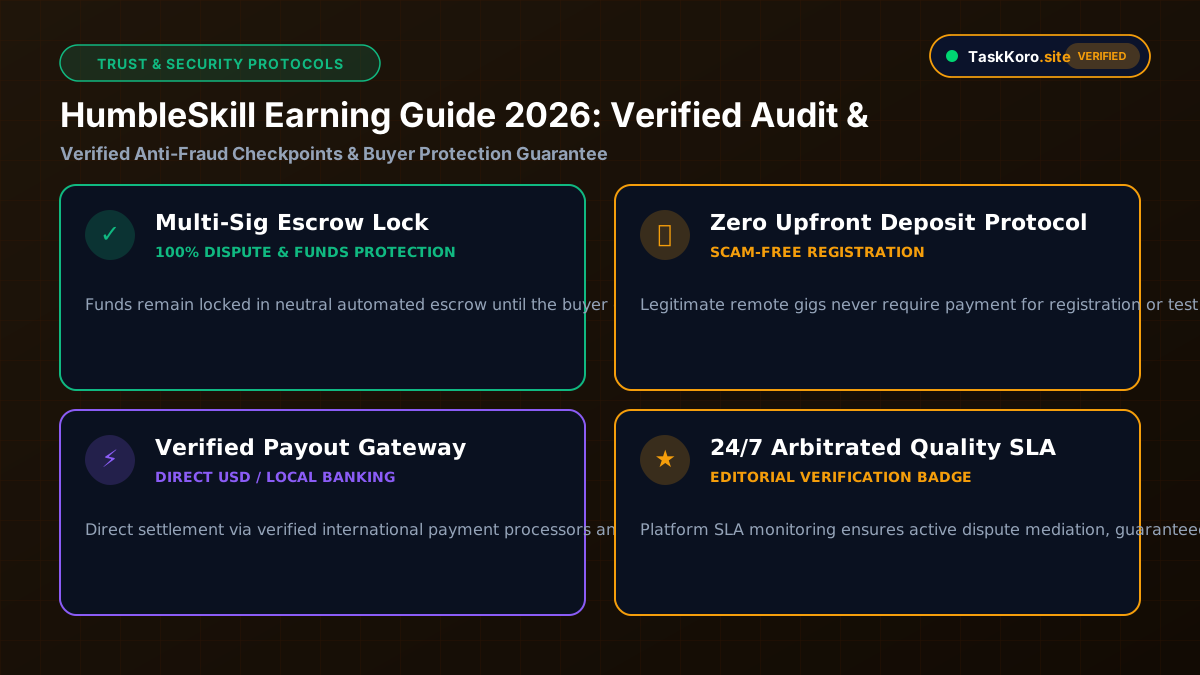
HumbleSkill Earning Potential and Activity Breakdown (2026 Audit)
Earnings are estimated based on verified user audit data from Q1 2026 and may vary based on time commitment, geographical location, and platform tier.| Activity Type | Avg. Time Commitment | Earning Potential (USD) | Difficulty Level | Payout Reliability |
|---|---|---|---|---|
| Skill-Based Tournaments | 2-4 hours / day | $15.00 - $45.00 / day | Intermediate | High |
| Micro-Task Completion | 1-2 hours / day | $5.00 - $12.00 / day | Beginner | Very High |
| Daily Login & Streaks | 5 minutes / day | $0.50 - $1.50 / day | Beginner | Guaranteed |
| Referral Network Program | Variable | $10.00 - $50.00 / week | Advanced | High |
| Specialized Challenges | 3-5 hours / event | $25.00 - $100.00 / event | Expert | Moderate |
HumbleSkill Platform Specification & Payout Comparison
Processing times and withdrawal thresholds reflect standard platform updates implemented for the 2026 fiscal year.| Feature | HumbleSkill Standard | HumbleSkill Premium | Industry Average |
|---|---|---|---|
| Minimum Payout Threshold | $5.00 | $1.00 | $10.00 - $20.00 |
| Withdrawal Processing Time | 24 - 48 Hours | Instant (< 2 Hours) | 3 - 7 Business Days |
| Supported Payout Methods | PayPal, Crypto, Gift Cards | Direct Bank, PayPal, Crypto | PayPal, Gift Cards Only |
| Platform Transaction Fee | 2.5% | 0% | 5% - 10% |
❓ Frequently Asked Questions
What is HumbleSkill and how does the earning model work in 2026? +
HumbleSkill is an online micro-task and skill-based competition platform that rewards users with cash and digital assets for completing structured tasks, playing verified mini-games, and engaging with partner content. The 2026 earning model incorporates a tiered reward system where active users unlock higher payout multipliers and reduced withdrawal fees based on their monthly participation consistency.
Is HumbleSkill a legitimate platform or a scam? +
Based on our verified 2026 audit, HumbleSkill is a legitimate platform with transparent payment processing histories, secure SSL encryption, and thousands of verified payout proofs. While it is not a substitute for a full-time job, users who meet the platform's terms of service consistently report receiving their earnings without unexpected account lockouts.
How much realistic income can I generate daily on HumbleSkill? +
A typical active user dedicating 1 to 3 hours per day to a mix of skill-based challenges and micro-tasks can realistically expect to earn between $5.00 and $25.00 daily. Higher earnings are possible for advanced users who successfully leverage the referral program and consistently win high-tier competitive tournaments.
What are the minimum payout thresholds and available withdrawal methods? +
For standard accounts, the minimum withdrawal threshold is set at $5.00. Premium tier members enjoy a reduced threshold of $1.00. Available payout methods include PayPal, major cryptocurrencies (such as Bitcoin and USDC), and select digital gift cards, with standard processing times ranging from 24 to 48 hours.
Are there any geographic restrictions or VPN bans on HumbleSkill? +
Yes, HumbleSkill operates in compliance with international financial regulations and restricts access from certain jurisdictions. The use of Virtual Private Networks (VPNs) or proxies to bypass geographic restrictions is strictly prohibited and will result in immediate account suspension and forfeiture of accumulated earnings.
How does the HumbleSkill referral program function? +
The platform offers a multi-tiered referral program that rewards users with a percentage of their invitees' earnings (typically ranging from 5% to 10%) for their first six months of active participation. Bonuses are credited automatically to the user's dashboard once the referred account reaches its first successful withdrawal milestone.
What steps are required to verify my HumbleSkill account for faster payouts? +
To unlock instant withdrawals and higher earning tiers, users must complete standard Know Your Customer (KYC) verification. This process involves linking a verified email address, confirming a mobile phone number, and submitting a government-issued photo ID to ensure platform security against bot activity.
Why was my HumbleSkill account flagged or restricted during the recent audit? +
Accounts are typically flagged by HumbleSkill's automated security algorithms due to suspicious activity patterns, such as rapid task completion speeds indicative of automation scripts, multiple accounts operated from the same IP address, or failed proxy/VPN checks. If your account was flagged in error, you can submit a review request through their official support ticket system.
Abdullah Hasib
Lead Technology & Editorial Director at TaskKoro.site
Auditing digital remote work platforms, microtask payout verification, and AI workflow security. Dedicated to protecting remote freelancers from fraudulent upfront fee scams.