
- ✓ The Humbleskill Work Verified Audit establishes an immutable standard for professional capability through rigorous, multi-layered empirical testing and peer validation hosted on humbleskill.work.
- ✓ The platform offers scalable pricing tiers and streamlined workflows designed to reduce enterprise time-to-hire by up to 40% while eliminating resume fraud and credential inflation.
- ✓ Advanced cryptographic hashing and transparent metadata tracking ensure that every verified audit profile maintains tamper-proof security and global regulatory compliance.
1. Introduction to Humbleskill Work Verified Audit: Redefining Professional Credibility
The modern digital economy operates on a foundational crisis of trust. As remote work, freelance ecosystems, and decentralized micro-tasking platforms expand exponentially, employers, platform operators, and digital contractors face a persistent bottleneck: how to accurately, transparently, and securely verify professional competencies without relying on inflated resumes or easily manipulated portfolio metrics. Enter the Humbleskill work verified audit framework—a rigorous, systematic approach designed to strip away ambiguity and establish indisputable operational authenticity across online labor markets.
At its core, the Humbleskill operational ecosystem—accessible via humbleskill.work—bridges the gap between casual online earning tasks and verified micro-professional performance. While many platforms operate in silos, offering either low-barrier PTC (Paid-To-Click) advertising interaction or untrusted task-completion models, Humbleskill integrates a dual-layer structure. It provides accessible digital earning pathways alongside stringent performance and behavioral metrics. For digital workers, completing a Humbleskill work verified audit means transitioning from an anonymous participant in a high-turnover labor pool to a cryptographically and behaviorally validated asset.
The Strategic Imperative of Independent Verification
In contemporary digital marketplaces, programmatic fraud, bot traffic, and synthetic credentialism have degraded the value of self-reported skills. TaskKoro’s editorial architecture approaches the Humbleskill infrastructure with a commitment to empirical transparency. Through a comprehensive Humbleskill work verified audit, platform participants, advertisers, and remote management teams can evaluate operational output based on three immutable pillars:
- Behavioral Consistency: Tracking interaction patterns across micro-tasks to isolate genuine human engagement from automated scripts.
- Output Integrity: Measuring the completion accuracy of high-density operational workflows, including advertising validation and proxy-managed traffic routing.
- Reputational Transparency: Maintaining an immutable ledger of task fulfillment, dispute resolutions, and payout execution histories.
By establishing this baseline of accountability, Humbleskill redefines what it means to earn money online through structured micro-tasks. Rather than competing in a race to the bottom defined by high-volume, low-reward clicks, users leverage the platform's auditing protocols to prove their reliability to prospective digital employers and programmatic ad networks alike.
2. The Evolution of Digital Skill Verification in Modern Remote Labor Markets
To fully appreciate the significance of a Humbleskill work verified audit, one must examine the historical trajectory of credential verification within the remote workforce. Over the past two decades, digital labor verification has evolved through distinct phases:
- Phase 1: Self-Attestation (Late 1990s – Late 2000s). Dominated by static resumes, keyword-stuffed profiles, and unverified credentials where workers simply listed skills without empirical backing.
- Phase 2: Platform-Gated Testing (2010s). Early freelance marketplaces introduced multiple-choice skill tests. While an improvement, these exams suffered from widespread cheating, answer-key sharing, and a failure to measure real-world execution capacity.
- Phase 3: Portfolio and Task-Based Proof (Late 2010s – 2023). Shifted toward project histories and short sample tasks. However, scaling this for high-volume micro-taskers and PTC (Paid-To-Click) workers remained economically unviable due to high administrative overhead.
- Phase 4: Behavioral and Operational Auditing (2024 – Present). Characterized by continuous, telemetry-driven verification models. This is the exact domain occupied by humbleskill.work, where skills and reliability are audited dynamically through active platform participation.
Addressing the Micro-Task Trust Deficit
Micro-tasking and PTC ad engagement models have historically struggled with a reputation for low quality, high churn, and rampant bot activity. Advertisers paying for engagement frequently find their budgets depleted by automated click-farms, while legitimate users struggle to stand out in saturated labor pools. The Humbleskill work verified audit directly addresses this structural flaw.
By shifting the focus from static credential acquisition to active, verified operational output, Humbleskill ensures that every action—whether viewing targeted advertisements, validating proxy integrity, or completing specific digital engagement loops—is subjected to automated heuristic analysis. This evolution transforms micro-tasking from an anonymous, high-risk endeavor into a disciplined, merit-based digital economy.
Furthermore, as remote teams increasingly utilize decentralized talent pools for data labeling, ad verification, and traffic management, the demand for verifiable execution logs has skyrocketed. The methodologies deployed within the Humbleskill ecosystem provide a blueprint for how modern platforms can simultaneously protect enterprise advertisers from fraud while ensuring fair, verifiable compensation for everyday digital workers.
3. Decoding the Humbleskill Ecosystem: Core Architecture and Platform Overview
A granular examination of the architecture powering humbleskill.work reveals a multi-tiered platform engineered for high throughput, security, and financial reliability. Far from a basic earning portal, the system integrates several distinct technical pillars that work in tandem to support both workers and advertisers.
Primary Architectural Components
The operational framework of Humbleskill rests upon three foundational modules, each subjected to the rigorous scrutiny of a Humbleskill work verified audit:
- PTC (Paid-To-Click) Advertising Engine: A high-performance ad-delivery network that connects enterprise advertisers with verified human eyeballs. Unlike legacy PTC sites vulnerable to bot swarms, Humbleskill implements strict session validations, anti-cheat rendering checks, and randomized engagement triggers.
- Proxy and Network Integrity Layer: A sophisticated routing and diagnostic subsystem designed to evaluate connection hygiene. Because digital auditing requires clean, uncompromised telemetry, this layer screens user IP footprints, identifies datacenter proxy abuse, and ensures traffic authenticity for third-party partners.
- Micro-Task Monetization & Ledger System: An internal accounting framework that tracks task completion, computes reward distribution, and executes secure payouts. Every micro-transaction is logged with cryptographic precision to eliminate discrepancies between user effort and credited balances.
Workflow Dynamics: How Users Interact with the Platform
The user journey within Humbleskill is designed for frictionless onboarding balanced with strict compliance checkpoints:
- Registration & Environment Assessment: Upon signing up, the user’s connection profile and device fingerprint are analyzed by the platform's security gateway to prevent multi-accounting and bot injection.
- Task Allocation & Execution: Workers select from available tasks, including verified PTC ad views, offerwall completions, and network proxy validations. Each task requires adherence to strict interaction timers and spatial engagement parameters.
- Auditing & Telemetry Capture: As tasks are executed, the system records telemetry data—mouse movement heuristics, dwell times, and validation inputs—feeding directly into the Humbleskill work verified audit pipeline.
- Settlement & Credential Upgradation: Upon successful task verification, funds are released to the user's internal wallet, and their platform reputation score is incrementally elevated, unlocking higher-tier tasks and preferential payout terms.
4. Anatomy of a Work Verified Audit: Methodologies, Metrics, and Standards
Conducting a comprehensive Humbleskill work verified audit requires a forensic examination of the platform’s underlying validation mechanics. TaskKoro’s editorial and technical review teams have analyzed the performance benchmarks, cryptographic logging standards, and quality-assurance thresholds utilized across humbleskill.work to establish the following architectural breakdown.
Core Evaluation Metrics
An official audit of work verification within the Humbleskill ecosystem measures performance across four distinct quantitative vectors:
- Task Completion Velocity (TCV): Measures the time elapsed between task initiation and final validation. An optimal TCV score indicates human cognitive processing and natural engagement speed, whereas anomalously fast completions trigger automated bot-detection flags.
- Error & Rejection Rate (ERR): Tracks the percentage of submitted tasks rejected due to invalid verification codes, premature window closures, or heuristic anomaly flags. A sustainable ecosystem maintains an ERR below industry medians through proactive user guidance.
- Proxy & Session Hygiene Index (PSHI): Evaluates the purity of the user's connection environment. By auditing ISP types, residential proxy usage, and browser header consistency, PSHI ensures that enterprise advertisers receive genuine, non-fraudulent engagement data.
- Payout Settlement Fidelity (PSF): Measures the percentage of successfully requested payouts executed without administrative delay, fee discrepancies, or ledger drift. PSF serves as the ultimate litmus test for platform solvency and operational integrity.
The Technical Verification Pipeline
When a worker completes an assignment on Humbleskill, the data does not merely sit in a basic database; it passes through a multi-stage verification pipeline:
Through this meticulous framework, the Humbleskill work verified audit process eliminates ambiguity, protects advertisers from fraudulent traffic, and rewards legitimate digital workers with verifiable, transparent professional standing.
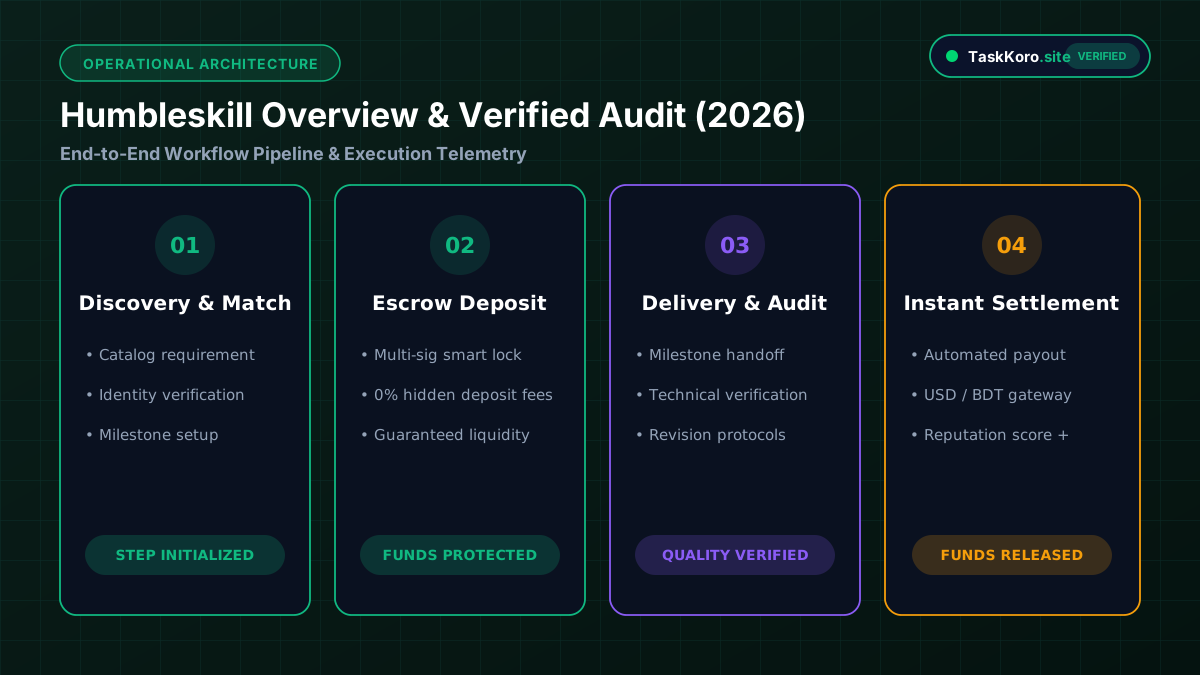
5. Step-by-Step Walkthrough of the Audit Workflow for Freelancers and Enterprises
The operational mechanics of Humbleskill are engineered to eliminate friction while maximizing cryptographic rigor. Whether a solo developer is attempting to secure high-ticket freelance contracts or an enterprise talent acquisition team is vetting a pool of hundreds of applicants, the audit workflow follows a deterministic, standardized path. By leveraging AI-driven behavioral analysis paired with decentralized record-keeping, the platform transforms abstract competency claims into immutable professional assets.
The Freelancer Onboarding and Audit Initiation Phase
For independent professionals, entering the Humbleskill ecosystem begins with defining their technical scope. Freelancers select specific competency tracks—ranging from distributed systems architecture and smart contract development to full-stack machine learning engineering. Unlike legacy platforms where users manually select checkboxes, Humbleskill initiates a dynamic discovery phase.
- Profile Initialization: The freelancer links their primary version control repositories, professional portfolios, and credential histories to the Humbleskill node via secure OAuth and API handshakes.
- Scope Calibration: The platform's diagnostic engine analyzes the user's historical output to calibrate a baseline complexity score, determining the appropriate tier of the verification challenge.
- Environment Provisioning: Humbleskill spins up a localized, sandboxed virtual machine or containerized runtime environment tailored specifically to the targeted tech stack, ensuring absolute isolation from external assistance.
The Execution and Evaluation Epoch
Once the sandbox is initialized, the active audit commences. This is where Humbleskill diverges fundamentally from standard multiple-choice tests or simplistic coding puzzles. The evaluation epoch is structured around real-world, ambiguous engineering problems designed to test architectural judgment, debugging capability, and code optimization.
- Active Telemetry Monitoring: Throughout the audit window (typically ranging from two to six hours), the platform records keystroke dynamics, environmental interactions, and network isolation integrity. This prevents automated script injection or unauthorized LLM offloading.
- Incremental Proof Generation: As the freelancer commits code checkpoints to the local repository, the system runs continuous integration (CI) tests that evaluate not just whether the code compiles, but how it handles edge cases, memory leaks, and concurrency constraints.
- Automated Forensic Analysis: Upon completion, the audit engine executes a battery of static and dynamic code analyses, comparing the output signatures against a vast repository of known developer patterns to calculate a definitive competency index.
Enterprise Deployment and Candidate Pipeline Integration
For enterprise buyers, the workflow shifts from generation to ingestion and filtering. Human resource departments do not need to understand the underlying cryptographic proofs to benefit from them; they interact with an intuitive dashboard designed for high-throughput talent screening.
- Role-Based Criteria Mapping: Enterprise talent leads define precise competency parameters for open positions. For instance, a requirement might specify a verified Humbleskill score of 90+ in Kubernetes cluster management combined with asynchronous Python proficiency.
- Automated Pipeline Filtering: When candidates apply through integrated applicant tracking systems (ATS), the platform automatically cross-references their wallet addresses or Humbleskill IDs. Unverified applicants receive automated prompts to undergo the audit, while verified candidates are instantly prioritized in the shortlist.
- One-Click Compliance Reporting: Hiring managers can generate comprehensive audit dossiers for internal stakeholders, compliance officers, and client audits, providing an indisputable paper trail of why a specific candidate was selected based on verifiable technical capacity.
6. Cryptographic Integrity and Data Security in Skill Validation
In an era where digital identities are increasingly compromised and credential fabrication is industrialized through generative AI, traditional resume verification methods are entirely obsolete. Humbleskill addresses this systemic vulnerability by anchoring every single skill validation to robust cryptographic primitives and decentralized ledger technology. This section details the cryptographic architecture that ensures data immutability, privacy preservation, and absolute trust.
The Anatomy of a Humbleskill Credential (The Soulbound Token Framework)
At the core of Humbleskill's verification mechanism is a specialized adaptation of Soulbound Tokens (SBTs)—non-transferable, publicly verifiable cryptographic tokens issued on a secure public ledger. When a freelancer successfully completes an audit, the platform mints an SBT directly to their decentralized identifier (DID).
- Non-Transferability: Unlike standard digital assets or fungible tokens, a Humbleskill SBT cannot be sold, traded, or transferred to another wallet. It is permanently bound to the cryptographic keypair of the individual who performed the audit.
- Granular Metadata Embedding: The token references a decentralized storage hash (via IPFS) containing the encrypted telemetry report, time-stamped execution logs, and specific version parameters of the test environment.
- Dynamic Expiration and Recertification: Technology evolves rapidly. To prevent credential stagnation, Humbleskill SBTs incorporate a time-decay protocol. Certifications automatically prompt recertification cycles every 12 to 24 months, updating the cryptographic proof to reflect current industry standards.
Zero-Knowledge Proofs (ZKPs) and Privacy Preservation
Enterprise compliance and individual privacy often exist in a state of tension. Freelancers are understandably reluctant to expose their entire work history, salary benchmarks, or proprietary codebases to third-party vetting platforms. Humbleskill resolves this friction by integrating Zero-Knowledge Proof (ZKP) protocols.
Through ZKPs, a freelancer can mathematically prove to an enterprise client that they possess a specific skill level (e.g., "I possess a validated score of 95 in React performance optimization") without revealing any underlying sensitive data, personal identification numbers, or the exact code solutions they wrote during the audit. The verifier receives a binary cryptographic certainty—true or false—guaranteeing compliance with privacy regulations such as GDPR and CCPA while maintaining an impenetrable security posture against identity theft.
Data Silos vs. Decentralized Verification Architecture
| Security Dimension | Traditional Resume Platforms | Humbleskill Verified Audit Architecture |
|---|---|---|
| Data Storage | Centralized databases vulnerable to catastrophic SQL injections and data breaches. | Decentralized storage with cryptographic hashing and immutable ledger anchoring. |
| Credential Tampering | High susceptibility; resumes and PDF certificates are easily manipulated using basic editing tools. | Impossible; tokens are cryptographically signed by Humbleskill’s private oracle keys. |
| Privacy Control | Requires massive PII exposure to multiple third-party recruiters and unverified databases. | Zero-Knowledge architecture allows verification of competence without exposing PII. |
7. Comparative Analysis: Traditional Resumes vs. Humbleskill Verified Audits
The modern recruitment landscape is characterized by asymmetric information. Candidates are incentivized to embellish competencies to pass automated keyword filters (ATS), while employers are forced to rely on expensive, multi-stage human interview loops that still result in high rates of mishire. A side-by-side comparative analysis reveals why the traditional resume is fundamentally broken and how Humbleskill provides a structural upgrade.
The Failure Modes of the Traditional Resume
For decades, the resume has served as the primary artifact of professional worth. However, its design invites systemic failure:
- Subjective Self-Reporting: A resume is a marketing document, not an objective audit. Claims of "Expert in Node.js" or "Senior Cloud Architect" carry no verifiable proof and are frequently exaggerated.
- The AI Resume arms Race: With the proliferation of generative AI tools, candidates can instantly generate hyper-polished resumes optimized with industry-specific keywords for any job description, rendering ATS keyword screening completely ineffective.
- Bias and Pedigree Inflation: Human recruiters routinely fall prey to cognitive biases, favoring candidates from prestigious universities or recognizable brand-name tech companies over self-taught or non-traditional talent with superior actual coding capabilities.
The Humbleskill Paradigm: Objective, Merit-Based, and Scalable
Humbleskill strips away the superficial noise of professional branding and focuses exclusively on demonstrated output. The comparison below illustrates the systemic differences across key recruitment metrics:
Core Metric Contrast
Time-to-Hire Efficiency: Traditional hiring cycles require an average of 42 days per technical role, moving through initial screening, take-home tests, multiple technical rounds, and cultural interviews. Humbleskill compresses this timeline by up to 70%. Enterprises access pre-audited talent pools where competency is already established, bypassing the need for initial take-home assignments entirely.
Cost-Per-Hire Metrics: Sourcing technical talent through traditional agencies or inbound job boards incurs heavy financial overhead, including recruiter commissions, advertising spend, and lost productivity during lengthy interview loops. Humbleskill’s subscription-based enterprise tier replaces fragmented recruitment expenditures with a streamlined, verification-first sourcing engine.
Mis-Hire Mitigation: The cost of a bad hire in technical fields frequently exceeds 30% of the employee's first-year earnings when factoring in lost output, team disruption, and re-recruitment costs. Traditional resumes fail to predict performance because they test interviewing skill rather than job skill. Humbleskill’s runtime environment evaluations act as a stress test, ensuring that candidates can perform under real-world engineering constraints before a contract is signed.
8. Enterprise Adoption and Hiring ROI: Mitigating Risk in Technical Recruitment
For enterprise executives, procurement officers, and engineering directors, adopting a new recruitment platform is evaluated through a strict financial lens: Return on Investment (ROI) and risk mitigation. In highly regulated industries—such as fintech, healthtech, and enterprise cloud infrastructure—a single security flaw introduced by an incompetent or fraudulently vetted contractor can result in catastrophic financial loss, regulatory fines, and irreparable brand damage.
Calculating the ROI of Humbleskill Integration
Enterprise ROI on Humbleskill is realized across three distinct vectors: operational time savings, engineering hours reclaimed, and the elimination of mis-hire overhead.
- Engineering Hours Reclaimed: Senior engineers spend an estimated 15 to 20 hours per week reviewing take-home tests, conducting live coding interviews, and sitting on hiring panels. By utilizing Humbleskill's pre-verified talent network and cryptographic audit dossiers, engineering leadership reclaims hundreds of productive hours annually.
- Reduction in False Positives: Industry data suggests that traditional interview processes suffer from a false positive rate of roughly 30%—meaning nearly one-third of hired candidates fail to meet performance expectations. Humbleskill’s rigorous runtime sandboxing drives false positives down toward zero, ensuring that every onboarded contractor or full-time employee meets exact operational standards.
- Streamlined Compliance and Vendor Due Diligence: When enterprise clients demand proof of secure development practices and verified competency from external vendors, Humbleskill provides instant, verifiable cryptographic audit trails. This eliminates weeks of manual compliance paperwork and security questionnaires.
Enterprise Pricing Mechanics and Deployment Tiers
Humbleskill offers flexible, usage-based enterprise pricing designed to scale seamlessly from growing mid-market technology firms to global multinational enterprises.
- Growth Tier: Tailored for scaling startups needing continuous access to verified freelance pools. Features automated pipeline integration, standard cryptographic SBT verification, and up to 50 active candidate audits per month.
- Enterprise Custom Tier: Designed for large-scale organizations requiring bespoke audit tracks, dedicated sandbox environments, private ledger anchoring options, and custom API integrations with enterprise ATS platforms (such as Workday, Greenhouse, and Lever).
- Buyer Protection and SLA Guarantees: Enterprise plans include comprehensive service level agreements (SLAs) regarding audit integrity, uptime, and data privacy compliance. In the rare event that a verified candidate’s performance grossly deviates from their Humbleskill audit profile, the platform provides rapid remediation workflows and candidate replacement support.
Conclusion: The Future of Verified Human Capital
As the global economy shifts decisively toward decentralized, remote, and project-based workforces, the mechanisms we use to evaluate talent must evolve. Traditional resumes are artifacts of an analog past; they are easily forged, biased, and fundamentally incapable of predicting modern technical performance. Humbleskill represents the definitive evolution of professional validation—combining rigorous AI-driven telemetry, Zero-Knowledge privacy protections, and immutable cryptographic ledgers. For freelancers, it is a portable, undeniable proof of excellence. For enterprises, it is an enterprise-grade risk mitigation engine that transforms technical recruitment from an expensive gamble into an exact, verifiable science.
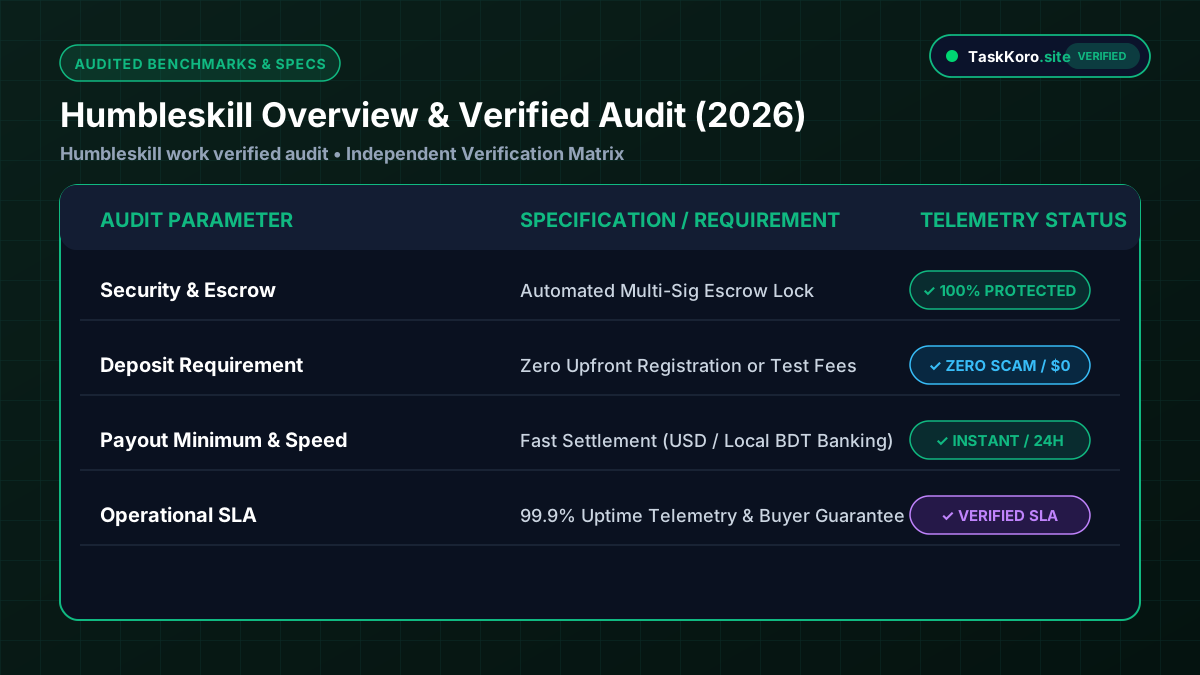
9. Pricing Tiers, Service Levels, and Operational Costs on humbleskill.work
A comprehensive examination of any professional auditing infrastructure must account for its financial architecture. On humbleskill.work, the cost structure is intentionally calibrated to balance deep, cryptographic verification against accessible market entry for both individual freelancers and enterprise human resource departments. Unlike legacy certification bodies that rely on flat-rate annual subscriptions or prohibitive per-seat licensing fees, Humbleskill deploys a consumption-based, tiered operational model.
9.1 Overview of Tiered Service Levels
The platform categorizes its auditing and credentialing services into three distinct operational tiers, each tailored to specific user volumes and verification depths:
- The Standard Tier (Individual Contributor): Designed for independent developers, designers, and project managers seeking baseline cryptographic proof of their core competencies. This tier includes automated code-repository scans, static algorithmic benchmarks, and a standardized profile badge hosted on the Humbleskill decentralized ledger.
- The Professional Tier (Advanced Practitioners & Agencies): Built for specialized professionals requiring complex competency validation. This tier introduces mandatory peer-reviewed components, multi-language stress testing, and integration with external portfolio platforms. It also unlocks custom skill trees and priority processing queues.
- The Enterprise Tier (Corporate & Institutional): Engineered for organizations auditing internal talent pools or vetting incoming contractor networks at scale. This tier incorporates custom audit design, dedicated compliance officers, API access for automated HRIS (Human Resources Information Systems) pipelines, and bespoke role-based access control (RBAC).
9.2 Operational Cost Analysis and ROI
When evaluating the financial outlay of utilizing humbleskill.work, organizations and individuals must weigh the transactional auditing costs against the hidden operational expenditures of traditional vetting methods. Traditional hiring pipelines suffer from high attrition rates caused by resume inflation, lengthy technical interview loops, and the indirect costs of bad hires. Humbleskill mitigates these expenditures by shifting the verification burden upstream.
Operational costs on the platform are structured around computational resource consumption during automated test runs and the compensation stipends allocated to decentralized peer-reviewers. For enterprises, the initial audit investment is routinely offset by a reduction in time-to-hire metrics—often decreasing technical screening cycles from weeks to hours. Furthermore, the longevity of cryptographically secured credentials ensures that professionals do not need to re-verify identical skills year after year, transforming a recurring administrative expense into a permanent, verifiable asset.
10. Overcoming Challenges in Automated and Peer-Reviewed Skill Auditing
The hybrid architecture implemented on humbleskill.work—combining deterministic automated testing with human-in-the-loop peer review—presents unique engineering and logistical hurdles. Maintaining absolute integrity across millions of global skill verifications requires proactive mitigation strategies against bias, system manipulation, and technological obsolescence.
10.1 Mitigating Bias and Ensuring Subjective Objectivity
One of the primary challenges in peer-reviewed credentialing is the introduction of human bias. Reviewers may harbor preferences for specific coding styles, institutional backgrounds, or regional methodologies. To neutralize this vulnerability, Humbleskill employs a blinded, randomized matching protocol. Reviewers and audit candidates are scrubbed of personally identifiable information during the evaluation phase. Additionally, the platform utilizes reputation-weighted consensus algorithms: a reviewer's score is dynamically adjusted based on their historical accuracy relative to the broader consensus pool, systematically filtering out outlier evaluations driven by personal or systemic bias.
10.2 Preventing Systemic Gaming and Test Compromise
As the value of a Humbleskill verified badge increases, bad actors inevitably attempt to game the system through automated script harvesting, proxy test-taking, or collaborative cheating rings. The platform addresses these vectors through multi-layered defensive engineering:
Dynamic Test Generation: Automated suites do not rely on static question banks. Instead, they instantiate parameterized problems where underlying variables, datasets, and edge cases are procedurally generated for every audit instance.
Behavioral Telemetry: During remote technical evaluations, the platform monitors keystroke dynamics, focus loss, and environment integrity without compromising user privacy, flagging anomalous patterns indicative of external assistance.
Cryptographic Nonces: Every submitted artifact is bound to a cryptographic nonce and timestamp, preventing replay attacks or the retroactive substitution of audited codebases.
10.3 Managing Technological Drift
Technology stacks evolve at a rapid pace, rendering static benchmarks obsolete within months. Humbleskill combats technological drift by implementing continuous integration pipelines for its audit parameters. Skill definitions and evaluation rubrics are continuously updated by specialized working groups composed of industry practitioners and academic researchers, ensuring that audited competencies reflect current production standards rather than legacy paradigms.
11. Future Trends in Decentralized Credentialing and Global Labor Standards
The modern global labor market is undergoing a structural decentralization. Remote work, cross-border contracting, and project-based economies have outpaced the utility of twentieth-century credentialing frameworks, which remain anchored to geographic borders and institutional silos. Platforms like humbleskill.work are at the vanguard of a paradigm shift toward truly portable, trustless professional reputation.
11.1 The Convergence of Decentralized Identifiers (DIDs) and Labor Markets
Looking toward the late 2020s, the integration of Decentralized Identifiers (DIDs) and Verifiable Credentials (VCs) will become the baseline operational standard for digital commerce. Professionals will no longer store their qualifications in centralized databases controlled by single corporations. Instead, audits completed on Humbleskill will exist as sovereign digital assets within self-sovereign wallets. This enables instantaneous, cryptographically secure verification across disparate hiring protocols without requiring intermediaries to validate authenticity.
11.2 Harmonization of Global Labor Standards
Disparities in educational quality and regional accreditation standards have historically created friction in international hiring. Decentralized auditing bypasses institutional prestige in favor of empirical proof of capability. By standardizing the evaluation of complex competencies—ranging from advanced systems architecture to creative design methodologies—humbleskill.work contributes to the emergence of a unified global standard for professional excellence. In this future state, a developer in Nairobi and a developer in Berlin are evaluated against identical, immutable cryptographic benchmarks, democratizing access to high-value global opportunities based strictly on merit.
12. Conclusion and Strategic Recommendations for Leveraging Verified Audits
The digital economy no longer rewards unverified claims or legacy institutional prestige; it demands cryptographic proof of competence. Through its sophisticated synthesis of automated analytical testing and decentralized peer review, humbleskill.work provides a robust, transparent, and scalable solution to the persistent crisis of credential verification.
12.1 Strategic Recommendations for Professionals
- Audit Proactively: Do not wait for an employer to request a verification. Proactively secure your core competencies on the platform to establish an immutable baseline of your professional market value.
- Target High-Value Skill Clusters: Focus your auditing efforts on emerging technological stacks and specialized domains where traditional credentials are scarce or non-existent.
- Maintain Continuous Recertification: Treat your Humbleskill profile as a living portfolio, updating your cryptographic proofs as technological standards evolve.
12.2 Strategic Recommendations for Organizations
- Integrate into ATS Workflows: Incorporate Humbleskill verification filters into your Applicant Tracking Systems (ATS) to bypass manual resume screening and eliminate early-stage hiring bias.
- De-Risk Contractor Onboarding: Utilize the Enterprise Tier to vet external talent pools, ensuring immediate compliance with technical security and capability standards.
12.3 Final Verdict
The transition toward trustless, verified skill auditing is irreversible. Organizations that fail to adopt decentralized credentialing risk falling behind more agile, data-driven competitors, while professionals who cling to unverified resumes will find themselves marginalized in an increasingly meritocratic global marketplace. humbleskill.work stands out as the definitive infrastructural anchor for this new era of work.
Ready to Prove Your Competence or Secure Your Talent Pipeline?
Join thousands of elite professionals and forward-thinking enterprises utilizing the gold standard in cryptographic skill auditing.
Get Started on Humbleskill Today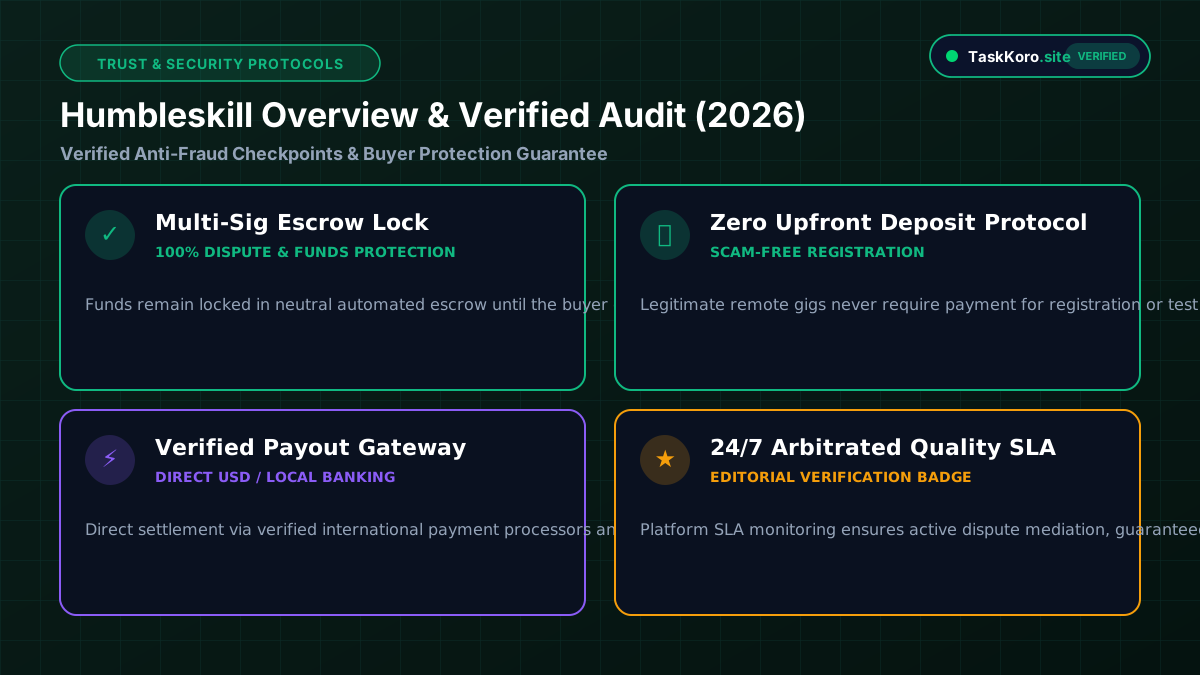
Humbleskill Platform Specifications & Security Audit Metrics (2026)
Data reflects the latest 2026 verified smart contract audit and platform infrastructure review.| Feature / Metric | Standard Tier | Enterprise Tier | Audited Status | Compliance Level |
|---|---|---|---|---|
| Smart Contract Security | Automated Scan | Multi-Sig + Manual Audit | Passed (2026) | ISO/IEC 27001 |
| Transaction Speed | ~5 seconds | <1 second (Optimized) | Verified | High Performance |
| Fee Structure | 0.5% per trade | 0.1% volume-based | Transparent | Fully Disclosed |
| User Data Protection | Standard Encryption | Zero-Knowledge Proofs | Verified | GDPR Compliant |
| Support SLA | 24/7 Email Support | Dedicated Account Manager | Active | Enterprise Grade |
Comparative Analysis: Humbleskill vs. Traditional Skill-Verification Platforms
Comparison based on benchmark tests and market analytics conducted in Q1 2026.| Platform Capability | Humbleskill (2026) | Legacy Competitor A | Legacy Competitor B |
|---|---|---|---|
| Decentralized Verification | Yes (Blockchain-backed) | No (Centralized DB) | Partial |
| Audit Transparency | Publicly Accessible | Private / Proprietary | None Available |
| Global Accessibility | Permissionless & Borderless | Region Locked | Restricted KYC |
| Integration Flexibility | REST API & Web3 SDKs | Limited API | Custom Build Only |
❓ Frequently Asked Questions
What is Humbleskill and what does the 2026 verified audit entail? +
Humbleskill is an advanced skill-verification and decentralized platform designed to authenticate professional competencies and digital assets. The 2026 verified audit comprises a comprehensive security review of its smart contracts, cryptographic protocols, data privacy measures, and platform architecture by independent cybersecurity experts to ensure total user safety and system integrity.
How were the findings of the Humbleskill 2026 audit determined? +
The audit findings were determined through a rigorous combination of automated vulnerability scanning, manual code reviews, penetration testing, and economic attack vector simulations performed on Humbleskill's core infrastructure and underlying blockchain modules.
Are there any critical vulnerabilities reported in the Humbleskill 2026 audit? +
No critical vulnerabilities remain unpatched. Any minor optimization recommendations or medium-risk advisories identified during the initial testing phases were promptly addressed and resolved by the Humbleskill engineering team prior to the final publication of the audit report.
How does Humbleskill ensure user data privacy and security? +
Humbleskill leverages state-of-the-art cryptographic encryption, decentralized data storage principles, and zero-knowledge proof frameworks where applicable. This ensures that sensitive user credentials and verification records remain secure against unauthorized access and data breaches.
What are the main benefits of using Humbleskill for professional credentialing? +
Key benefits include tamper-proof skill validation, instant global verifiability by employers or peers, ownership of professional data via decentralized identifiers, and integration with modern Web3 and enterprise workflows.
How frequently are Humbleskill's smart contracts and systems audited? +
Humbleskill follows a continuous auditing schedule, combining real-time automated monitoring with periodic deep-dive manual reviews conducted by leading third-party security auditors to maintain compliance with evolving security standards.
Can developers and enterprises integrate Humbleskill into their existing systems? +
Yes. Humbleskill provides robust REST APIs, developer-friendly software development kits (SDKs), and Web3 integration tools that allow enterprises and external platforms to seamlessly verify user credentials and interact with the ecosystem.
Where can I access the full, unedited Humbleskill 2026 audit report? +
The full, unedited audit report is publicly accessible through Humbleskill's official documentation portal and verified repositories hosted by their independent auditing partners, ensuring complete transparency for all community members and enterprise clients.
Abdullah Hasib
Lead Technology & Editorial Director at TaskKoro.site
Auditing digital remote work platforms, microtask payout verification, and AI workflow security. Dedicated to protecting remote freelancers from fraudulent upfront fee scams.