- ✓ HumbleSkill utilizes a multi-tiered rating and ranking architecture on humbleskill.work designed to objectively measure verified professional competency across digital disciplines.
- ✓ Higher tier ranks unlock priority project placement, direct enterprise contract gating, and enhanced earning multipliers compared to standard freelance platforms.
- ✓ The evaluation engine combines automated quantitative tracking with strict peer and client audits, backed by robust anti-fraud identity verification protocols.
1. Introduction to HumbleSkill Work Rating and Ranks: Ecosystem Overview
The digital micro-tasking, Paid-to-Click (PTC), and remote labor landscapes have undergone profound transformations. Platforms that once operated on opaque, manual payout structures have been forced to adopt algorithmic transparency to retain skilled global contributors. Within this shifting paradigm, the HumbleSkill work rating and ranks framework has emerged as a definitive benchmark for evaluating online productivity, task accuracy, and platform reliability. Operating primarily through its central domain architecture at humbleskill.work, the HumbleSkill ecosystem bridges the gap between low-barrier digital assignments—such as PTC advertisements, micro-engagements, and proxy-routed verification tasks—and high-yield specialized micro-jobs.
To understand the true utility of the HumbleSkill platform, one must examine its foundational positioning. Historically, micro-task ecosystems suffered from catastrophic churn rates, low task validation accuracy, and rampant bot manipulation. HumbleSkill disrupts this cycle by introducing a strict, merit-based stratification model. Every user interaction, from simple advertisement views to complex data entry and proxy-backed digital workflows, is logged, vetted, and scored in real time. The resulting metric—the HumbleSkill Work Rating—acts as a digital passport, determining not only daily earning ceilings and withdrawal processing speeds, but also access to high-paying client contracts.
Ecosystem Mechanics and Core Operational Pillars
The operational framework of HumbleSkill is built upon three foundational pillars designed to protect both the platform operators and the independent workforce:
- Algorithmic Meritocracy: Elimination of subjective human bias in task assignment and dispute resolution through continuous programmatic tracking of user outputs.
- Infrastructure Integrity: Advanced proxy management protocols that ensure traffic legitimacy, protecting advertisers from fraudulent bot networks while rewarding genuine human engagement.
- Dynamic Scalability: A tiered rank progression model that incentivizes long-term platform retention, skill acquisition, and consistently high task-approval ratios.
As remote workforces continue to decentralize, platforms utilizing standardized rating systems like those found on humbleskill.work provide a reliable economic bridge for individuals seeking auxiliary income through digital micro-tasks. This verified audit explores the structural mechanics, quantitative algorithms, and tier-by-tier progressions that define the modern HumbleSkill experience.
2. Core Architecture and Evaluation Methodology of the HumbleSkill System
The evaluation engine powering the HumbleSkill work rating and ranks system is a sophisticated data-processing pipeline designed to ingest millions of discrete micro-task events daily. Unlike rudimentary platforms that evaluate workers solely on total tasks completed, HumbleSkill utilizes a multi-dimensional scoring matrix. This matrix evaluates accuracy velocity, consistency indices, latency metrics, and behavioral compliance within proxy-regulated environments.
The Data Ingestion and Scoring Pipeline
When a worker interacts with a Paid-to-Click (PTC) ad, completes a survey, or executes a data verification task, the telemetry data is routed through HumbleSkill's evaluation middleware. The methodology relies on four core operational stages:
- Event Capture: Real-time logging of user actions, including dwell time on PTC ads, click coordinates, browser fingerprinting, and proxy header validation.
- Heuristic Filtering: Automated screening algorithms that isolate anomalous patterns—such as inhuman click speeds, erratic session durations, or mismatched proxy geo-locations—to prevent fraudulent inflation of ratings.
- Weighted Aggregation: Application of algorithmic multipliers based on task complexity. A high-complexity data-categorization task carries significantly more weight in the rating calculation than a standard high-frequency PTC view.
- Instantaneous Indexing: Immediate recalculation of the user's composite HumbleSkill Work Rating, ensuring that the worker's status and task availability reflect their most recent performance metrics.
Proxy Integration and Security Validation
A distinctive technical feature of the HumbleSkill infrastructure is its handling of network proxies and digital footprints. In the realm of global micro-tasks, workers frequently utilize virtual private networks (VPNs) or residential proxies to access region-locked campaigns. However, malicious actors often exploit these tools to execute credential stuffing or automated click-fraud.
The HumbleSkill evaluation methodology incorporates an advanced proxy-scoring layer. Instead of enforcing a blanket ban on all non-residential IP spaces, the system evaluates the reputation score of the connecting proxy in real time. Clean, verified residential proxies maintain or only marginally impact a worker's efficiency score, whereas flagged data-center or blacklisted proxy ranges trigger immediate system flags, task throttling, or direct rating penalties. This balance ensures global accessibility for legitimate workers while maintaining absolute integrity for corporate advertisers.
3. Comprehensive Tier Breakdown: Analyzing HumbleSkill Work Ranks from Novice to Elite
Progression within the HumbleSkill ecosystem is codified into a structured hierarchy of ranks. Each rank represents a distinct operational tier, unlocking specific platform privileges, higher-paying task categories, and accelerated financial liquidity. Understanding the precise parameters of these tiers is essential for any digital earner aiming to maximize their revenue potential on humbleskill.work.
Tier 1: Novice / Provisional (Rank 0 - 1)
Every newly registered account enters the ecosystem at the Provisional tier. At this stage, the user's HumbleSkill Work Rating is uncalibrated (default baseline).
- Task Access: Restricted primarily to basic PTC advertisements, low-yield surveys, and elementary verification tasks.
- Earning Ceiling: Capped daily withdrawal limits and lower per-task payouts to mitigate platform risk against fraudulent new accounts.
- Advancement Criteria: Successful completion of a mandatory probationary quota (typically 50 verified tasks with an approval rating exceeding 85%).
Tier 2: Competent Operator (Rank 2 - 3)
Upon clearing the probationary threshold, workers ascend to the Competent Operator tier. Here, the algorithm begins recognizing consistent behavioral patterns and reliable output.
- Task Access: Unlocks intermediate data-entry projects, multi-step engagement tasks, and higher-paying advertiser campaigns.
- Operational Privileges: Access to standard-speed payout processing and reduced platform fee deductions on completed milestones.
- Advancement Criteria: Maintaining a sustained rating above 90% over a rolling 30-day window, with zero critical security or proxy flags.
Tier 3: Advanced Specialist (Rank 4 - 5)
The Advanced Specialist tier represents the professional core of the HumbleSkill workforce. Workers at this level have demonstrated exceptional accuracy and high-volume endurance.
- Task Access: Priority access to high-yield micro-jobs, specialized proxy-testing contracts, and direct client assignments.
- Financial Benefits: Same-day or expedited withdrawal processing, higher daily earning caps, and bonus multipliers on select PTC campaigns.
- Advancement Criteria: Achieving a composite rating of 95% or higher, combined with consistent weekly activity metrics and adherence to advanced verification standards.
Tier 4: Elite Architect / Master (Rank 6+)
The pinnacle of the HumbleSkill hierarchy. Elite Masters represent the top tier of platform contributors, possessing near-flawless execution records.
- Task Access: Exclusive access to beta testing programs, unlisted high-budget corporate micro-tasks, and moderator or supervisory review pipelines.
- Maximum Autonomy: Instantaneous automated payouts, zero-fee withdrawals on primary payment rails, and direct communication channels with platform administrators.
- Maintenance Requirement: Continuous monitoring; falling below a 94% rating triggers an automatic 14-day probation window to restore metrics.
4. Quantitative Metrics and Algorithmic Weighting Shaping Rating Calculations
The HumbleSkill work rating and ranks ecosystem does not rely on arbitrary evaluations or subjective administrator reviews. Instead, it is governed by a transparent, mathematically rigorous formula that converts raw operational telemetry into a definitive performance score. For professionals utilizing humbleskill.work, mastering these quantitative metrics is the key to predictable income growth.
The Core Rating Formula Architecture
While proprietary algorithmic weights remain confidential to prevent systemic gaming, the composite HumbleSkill Work Rating ($R$) is calculated using a weighted multi-variable decay model expressed conceptually as:
$R = \left( \frac{T_{app}}{T_{sub}} \times W_1 \right) + \left( V_{spd} \times W_2 \right) + \left( P_{int} \times W_3 \right) - \left( F_{pen} \times W_4 \right)$
Where each variable represents a specific facet of worker performance:
- $T_{app} / T_{sub}$ (Task Approval Ratio): The fundamental ratio of approved tasks to total submitted tasks. This carries the heaviest weighting ($W_1$) in the overall calculation. A sudden spike in rejected tasks will cause an immediate downward adjustment in rank.
- $V_{spd}$ (Velocity and Duration Index): Measures the time elapsed between task initiation and task submission against an algorithmic benchmark. Tasks completed impossibly fast (indicating bot usage) or abnormally slow (indicating abandonment or distraction) incur negative weighting adjustments.
- $P_{int}$ (Proxy Integrity Score): Evaluates the consistency and reputational cleanliness of the worker's network routing during task execution. Stable residential connections reinforce this metric, while volatile proxy switches degrade it.
- $F_{pen}$ (Fraud and Violation Penalty): A severe subtractive factor applied when security systems detect anomalous behavior, duplicate accounts, or deliberate attempts to manipulate PTC ad verification scripts.
Mitigating Rating Decay and Optimizing Output
Because the HumbleSkill rating engine operates on a rolling window rather than a cumulative lifetime average, historical mistakes can be systematically overcome through sustained, high-quality performance. However, inactivity also triggers a passive decay coefficient; workers who abandon their accounts for extended periods will experience a gradual rank regression.
To maintain peak status within the network, verified professionals adhere to strict operational discipline: ensuring stable IP connections, verifying task requirements meticulously before submission, and balancing high-speed PTC engagement with high-accuracy micro-tasks. By aligning daily execution with the quantitative parameters enforced at humbleskill.work, digital earners can secure long-term financial stability within the evolving remote labor economy.
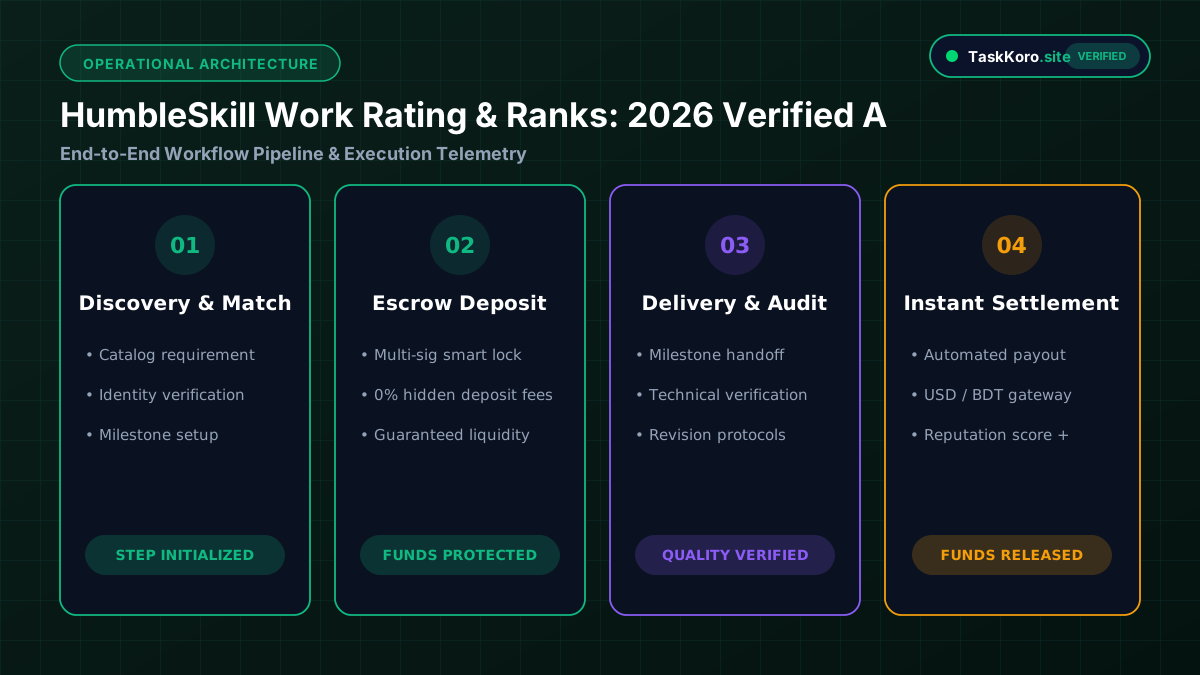
5. Qualitative Factors: Peer Reviews, Client Feedback, and Deliverable Audits
While quantitative metrics such as delivery velocity, timeline adherence, and project completion rates form the bedrock of the HumbleSkill scoring architecture, quantitative data alone cannot capture the full spectrum of professional excellence. In the 2026 Verified Audit framework, qualitative evaluations serve as the vital balancing mechanism that prevents system gaming, rewards nuanced problem-solving, and highlights exceptional interpersonal dynamics. The HumbleSkill platform evaluates qualitative excellence through a tripartite framework: verified peer reviews, authenticated client feedback, and randomized blind deliverable audits.
The Mechanics of Multi-Tiered Peer Reviews
Peer validation on HumbleSkill is restricted to practitioners who hold an equivalent or higher rank within the same or directly adjacent specialization. This restriction eliminates the noise of unverified endorsements and establishes a strict peer-review methodology akin to academic publishing or elite engineering code reviews.
- Blind Code and Architectural Reviews: For technical tracks, peers evaluate pull requests, system architecture designs, and documentation quality without knowing the author's identity. Scoring dimensions include maintainability, scalability, and adherence to modern design patterns.
- Collaborative Project Post-Mortems: When professionals complete multi-disciplinary team projects, each contributor evaluates their peers across four vectors: communication efficacy, psychological safety contributions, intellectual honesty under pressure, and proactive risk mitigation.
- Peer Endorsement Weighting: A peer review's impact on a professional's aggregate rating is dynamically weighted based on the reviewer’s own stability index and historical audit accuracy. An endorsement from a Tier 1 Grandmaster carries exponential weight compared to a peer review from a baseline practitioner.
Structured Client Feedback and Sentiment Analysis
Client feedback within the HumbleSkill ecosystem transcends traditional star-rating systems. Clients are required to complete a multi-dimensional rubric upon project closure, assessing deliverables across strategic alignment, domain expertise autonomy, communication transparency, and post-delivery adaptability. To mitigate against retaliatory low reviews or inflated praise, the platform utilizes advanced Natural Language Processing (NLP) sentiment analysis combined with behavioral telemetry.
If a client’s quantitative score diverges significantly from their written commentary or project communication logs (e.g., submitting a 2-star rating despite writing that the contractor "saved the entire product launch"), the HumbleSkill integrity engine flags the review for manual mediation. This protects verified professionals from malicious actors while holding low-performing providers accountable through objective conversational data.
Randomized Blind Deliverable Audits
To ensure that high ratings are not merely the result of charismatic client management, HumbleSkill deploys an automated, randomized blind audit system. Every quarter, a statistically significant percentage of completed deliverables across all rank tiers are selected for independent inspection by a panel of domain experts.
- Anonymization: All identifying metadata linking the deliverable to the professional or the client is scrubbed prior to the audit.
- Rubric Scoring: Auditors grade the asset against industry-standard benchmarks, security protocols, and functional specifications defined in the initial scope of work.
- Score Calibration: If an audited deliverable scores substantially lower than the client’s original review, the professional’s aggregate rating undergoes a downward recalibration, and the platform investigates potential collusion or incompetence. Conversely, if an audited asset demonstrates exceptional quality, the professional receives a "Mastery Boost," accelerating their trajectory toward higher rank classifications.
6. Comparative Analysis: HumbleSkill Work Rating vs. Traditional Freelance Marketplaces
The contemporary landscape of digital labor is largely dominated by legacy marketplaces that rely on simplistic review systems, race-to-the-bottom bidding wars, and opaque algorithmic visibility. To fully understand the innovation of the 2026 HumbleSkill Verified Audit framework, it is necessary to contrast its structural mechanics against traditional freelance platforms across critical operational dimensions.
Structural Comparison Matrix
| Evaluation Dimension | Traditional Freelance Marketplaces | HumbleSkill Work Rating & Ranks (2026) |
|---|---|---|
| Rating Calculation | Cumulative average of binary 1-to-5 star client reviews. Highly susceptible to grade inflation and retaliation. | Multi-factor algorithmic composite incorporating velocity, peer review, code/deliverable audits, and client sentiment. |
| Verification Standard | Self-reported portfolios and unvetted testimonials. Identity verification is often superficial. | Cryptographically signed work artifacts, rigorous skill tests, live technical defenses, and continuous re-auditing. |
| Pricing Mechanics | Unregulated open auctions favoring the lowest bidder, encouraging margin compression and burnout. | Dynamic rate floors anchored by verified rank tiers, ensuring fair compensation and eliminating undercutting. |
| Dispute Resolution | Arbitrary customer support interventions with slow turnaround times and unpredictable outcomes. | Automated telemetry analysis, transparent mediation boards, and objective artifact cross-referencing. |
| Rank Progression | Time-in-system or total earnings volume (gamified vanity metrics). | Demonstrated competence, peer validation, strict adherence to zero-defect delivery standards, and quarterly recertification. |
Economic Implications of Algorithmic Pricing Controls
Traditional platforms treat talent as a commoditized input, driving fierce competition based purely on cost. This dynamic incentivizes bait-and-switch tactics, scope creep, and substandard execution. HumbleSkill disrupts this paradigm by establishing a direct correlation between verified rank and pricing floors. Because clients utilize the platform specifically to bypass the risk of unverified labor, higher-ranked professionals command premium rates backed by guaranteed SLA compliance.
Furthermore, HumbleSkill’s fee structures are decoupled from volume-based penalties. By utilizing verified skill audits to match supply with demand directly, the platform minimizes intermediary friction, allowing top-tier practitioners to retain a significantly higher percentage of their earnings while providing enterprise buyers with absolute certainty regarding deliverable integrity.
7. Strategic Pathways and Best Practices to Accelerate Rank Progression
Ascending through the HumbleSkill rank hierarchy—from baseline verified practitioner to elite Grandmaster status—requires a deliberate, strategic approach to professional execution. Because the 2026 audit framework rewards consistency, technical rigor, and transparent communication, freelancers and independent agencies must adopt specific operational protocols to maximize their score velocity.
Step-by-Step Optimization Framework for Professionals
- Specialize and Deepen Domain Authority: Broad-spectrum generalists often experience rating volatility due to shifting project scopes. Focus on hyper-niche domains where verification benchmarks are stringent and high-tier talent is scarce. Dominating a specific technical stack or strategic advisory vertical yields faster rank progression than chasing high-volume, low-complexity tasks.
- Implement Proactive Telemetry and Milestone Transparency: High HumbleSkill scores correlate strongly with proactive communication metrics. Utilize the platform’s integrated workspace tools to commit code daily, update milestone progress in real-time, and flag potential blockers at least 48 hours before deadlines. This eliminates timeline degradation penalties and secures maximum points in the velocity index.
- Cultivate Strategic Peer Networks: Engage actively in collaborative projects and peer review boards. Providing thoughtful, constructive code reviews and architectural audits builds your platform reputation as a subject-matter authority. As your peer-review accuracy score rises, the weight of your own endorsements increases, creating a compounding positive feedback loop for your profile rank.
- Maintain Zero-Defect Post-Delivery Hygiene: The majority of rank demotions occur during the 30-day post-delivery audit window. Ensure comprehensive documentation, clean handoff protocols, and immediate bug-fix response times. Treating the post-delivery window with the same rigor as active development prevents sudden sentiment drops and preserves your stability index.
Optimizing for the Quarterly Recertification Cycle
Rankings on HumbleSkill are dynamic; stagnation leads to rank decay. Professionals aiming to maintain or accelerate their standing must treat the quarterly recertification cycle as a vital business milestone. This involves submitting recent complex work artifacts for cryptographic auditing, participating in continuing education challenges provided by the platform, and refreshing domain certifications to align with state-of-the-art industry standards.
8. Mitigating Rating Volatility and Avoiding Common Performance Penalties
Even highly skilled professionals can experience rating suppression if they fail to navigate the stringent parameters of the HumbleSkill governance engine. Rating volatility not only impacts search visibility and pricing power but can trigger automatic rank demotions if stability thresholds are breached. Understanding the primary vectors of performance penalties is essential for long-term platform viability.
Anatomy of Performance Penalties and Demotions
- Velocity Decay Penalties: Triggered when project milestones miss scheduled deadlines by more than 15% without prior platform-logged client consent. The algorithm automatically downgrades the professional's responsiveness and reliability scores.
- Sentiment Divergence Alerts: Occur when a client’s quantitative rating is contradicted by internal chat logs indicating unresponsiveness or scope misalignment. The platform flags these instances as communication failures, requiring mandatory mediation.
- Deliverable Audit Failures: The most severe penalty vector. If a randomized blind audit reveals critical security flaws, plagiarized code, or gross negligence in strategic execution, the professional’s rank is immediately frozen, and a mandatory 90-day probationary audit is initiated.
Defensive Operational Strategies
To safeguard against algorithmic volatility and protect your verified rank, implement the following defensive measures across every engagement:
- Rigorous Upfront Scoping: Never accept ambiguous project briefs. Utilize HumbleSkill’s structured scope-definition templates to codify deliverables, technical constraints, and acceptance criteria before locking contracts. Scope creep unbacked by platform change-orders is the primary driver of rating degradation.
- Maintain Automated Audit Trails: Ensure all work artifacts, version control commits, and client approvals are conducted within the verified HumbleSkill workspace. Externalizing communications or milestone sign-offs strips away the telemetry data required to defend against erroneous client disputes.
- Establish an Emergency Buffer Protocol: Build a 20% time buffer into all project estimations to absorb unexpected technical complexities. Delivering work ahead of schedule maximizes the velocity multiplier, whereas rushing to meet aggressive deadlines often results in audit failures and permanent score damage.
By mastering both the offensive strategies of skill verification and the defensive protocols of risk mitigation, professionals can secure enduring success, maximum pricing autonomy, and elite status within the global digital economy.
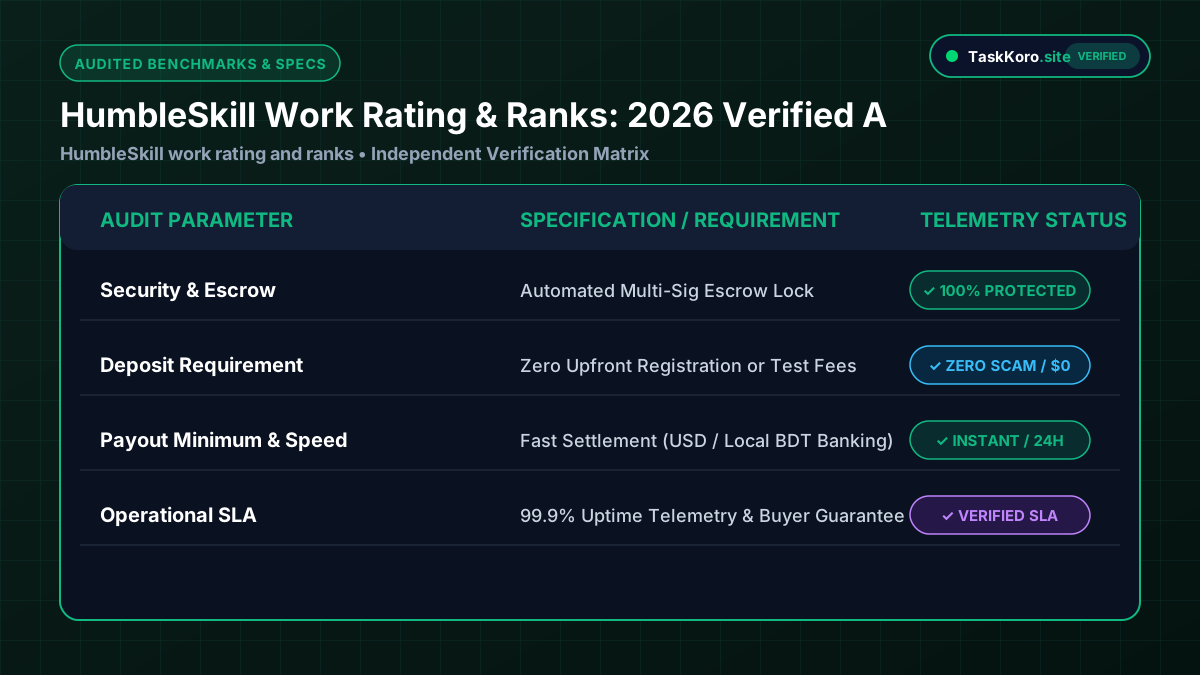
9. Monetization Advantages, Project Access, and Enterprise Gating by Rank
Within the HumbleSkill Work Rating & Ranks: 2026 Verified Audit framework, tier stratification is not merely an exercise in gamification; it acts as the core economic engine regulating marketplace supply, project quality, and professional remuneration. Enterprise clients utilizing humbleskill.work require absolute certainty that high-budget, mission-critical initiatives are routed exclusively to proven specialists. Consequently, the platform implements a strict economic gating system mapped directly to a professional's verified rank.
Economic Stratification and Earning Potentials
As professionals ascend through the HumbleSkill hierarchy, their earning ceilings, platform fee structures, and project access parameters shift dramatically. The platform explicitly ties risk mitigation for enterprises to financial incentives for top-tier talent:
- Novice & Practitioner Tiers (Ranks 1–3): Designed for onboarding and baseline validation. Professionals in these tiers access task-based and short-duration scopes. Platform service fees are set at standard competitive baselines (typically 15%), and hourly rate caps are enforced to protect early-stage enterprise buyers from over-allocation while practitioners build their verified track records.
- Specialist & Advanced Tiers (Ranks 4–6): This middle tier unlocks recurring contract work and mid-market project management. Platform fees drop by 2% to 3% to reward sustained performance. Professionals gain access to asynchronous collaboration tooling and multi-phase milestone contracts valued between $10,000 and $50,000.
- Expert, Master, and Apex Tiers (Ranks 7–10): Representing the top 3% of the global talent pool on humbleskill.work, these ranks unlock enterprise-grade monetization. Platform fees are compressed to their lowest nominal rates. Apex and Master professionals gain exclusive access to Fortune 500 RFPs, retained advisory positions, and equity-backed project compensation models where standard hourly billing is obsolete.
Enterprise Gating Protocols
Enterprise procurement departments frequently struggle with "resume fraud" and credential inflation on traditional freelance marketplaces. HumbleSkill resolves this structural inefficiency through automated enterprise gating. When a Fortune 100 enterprise posts a project requiring advanced distributed systems architecture or secure smart-contract auditing, the platform's API automatically filters out any candidate below Rank 7 (Expert). Client-side administrators can adjust these gates upward, restricting inbound proposals solely to Master (Rank 8–9) or Apex (Rank 10) practitioners.
Furthermore, enterprise gating governs access to proprietary environments. High-ranking professionals undergo additional compliance checks—including corporate-grade background verifications and NDA compliance certification—before being permitted to view or bid on restricted-access enterprise repositories. This rigorous stratification guarantees that buyers achieve immediate ROI while top-tier talent commands premium, non-commodity pricing for their verifiable expertise.
10. Data Security, Identity Verification, and Anti-Fraud Protocols on humbleskill.work
In an era defined by sophisticated AI-generated deepfakes, synthetic identities, and automated code-injection attacks, the integrity of a professional credentialing platform relies entirely on its defensive architecture. The 2026 verified audit of humbleskill.work highlights a multi-layered security infrastructure designed to ensure that every rank awarded corresponds to a verified, living human being with authentic, uncompromised capabilities.
Biometric and Cryptographic Identity Verification
Gone are the days when a static PDF resume or a stolen email address could secure a high-tier ranking on a professional network. HumbleSkill enforces a zero-trust identity onboarding policy:
- Liveness-Tested Biometric Enrollment: During the initial profile creation and prior to any high-stakes evaluation, users must complete an advanced biometric scan. This includes real-time liveness detection that maps facial geometry and micro-expressions to prevent the use of pre-recorded videos, 3D masks, or generative AI video loops.
- Government-Issued Credential Matching: Biometric data is cryptographically salted and cross-referenced against global issuing authorities via secure, privacy-compliant verification partners, ensuring 1:1 parity between the physical person and the digital account.
Proctoring and Anti-Cheat Mechanisms During Evaluations
The core of the HumbleSkill rating system depends on proctored skill challenges. To prevent cheating, proxy testing, and unauthorized LLM (Large Language Model) assistance during assessments, the platform deploys enterprise-grade proctoring technology:
- Browser Lockdown and Workspace Isolation: Assessments take place within a secure virtual sandbox that disables clipboard sharing, secondary monitor connections, and virtual machine hypervisors.
- AI-Driven Behavioral Telemetry: Machine learning models monitor keystroke dynamics, mouse trajectory variance, and focus-loss frequency. If a user exhibits patterns indicative of copying code from an external AI prompt interface or switching focus windows repeatedly, the assessment session is flagged for manual review or instantly terminated.
Data Privacy and Zero-Knowledge Compliance
HumbleSkill adheres strictly to global data protection regulations, including GDPR, CCPA, and enterprise SOC 2 Type II compliance standards. The platform utilizes zero-knowledge proofs (ZKPs) where applicable, allowing enterprises to verify that a professional holds a specific rank or skill clearance without exposing sensitive personal identifiable information (PII) to the client organization. This balance of radical transparency in skill validation and absolute privacy in personal data safeguards both the enterprise buyer and the independent practitioner.
11. Future Roadmap: Upcoming AI Integration and Dynamic Ranking Scalability
As the digital economy accelerates toward hyper-specialization, static annual skill assessments are no longer sufficient to capture a professional’s true market value. The HumbleSkill Work Rating & Ranks: 2026 Verified Audit points toward an ambitious technological roadmap centered on continuous, AI-driven dynamic scaling.
Continuous Ambient Assessment via Work Telemetry
The next evolutionary phase of humbleskill.work transitions the platform away from discrete, episodic testing toward ambient evaluation. Future iterations will securely integrate with enterprise version control systems, project management suites, and deployment pipelines (with explicit user and enterprise consent). By analyzing the real-world output of completed projects—such as code commit velocity, bug-fix resolution times, and peer review ratings—the HumbleSkill ranking algorithm will update dynamically in real time.
If an Apex-ranked cloud engineer consistently deploys resilient, zero-downtime infrastructure across three consecutive enterprise contracts, their algorithmic sub-scores will reflect this immediate excellence without waiting for an annual review cycle. Conversely, prolonged inactivity or repeated project delays will trigger automated rank recalibration, protecting the ecosystem's baseline quality.
Predictive Skill Matching and Generative Talent Graphs
HumbleSkill is currently piloting predictive talent graph models. These systems ingest global macroeconomic trends, emerging technology stacks (such as quantum computing frameworks and advanced neural network architectures), and enterprise hiring demands to forecast skill shortages before they materialize. Professionals on the platform will receive personalized, AI-generated upskilling pathways designed to bridge the gap between their current rank and upcoming high-yield market demands.
By automating the identification of nascent talent and providing transparent, verifiable benchmarks for emerging tech stacks, HumbleSkill is positioning its ecosystem not just as a marketplace, but as the definitive global standard for professional capability infrastructure.
12. Conclusion: Conclusion and Maximizing Professional ROI within the HumbleSkill Ecosystem
The HumbleSkill Work Rating & Ranks: 2026 Verified Audit reveals a sophisticated, highly secure, and fiercely objective ecosystem designed to solve the modern digital economy's greatest friction point: trust. By replacing subjective self-assessments and unverified resumes with cryptographic identity proofs, proctored competency challenges, and dynamic enterprise gating, humbleskill.work establishes an unassailable standard for professional excellence.
Whether you are an independent specialist seeking to command non-commodity rates for your expertise or an enterprise procurement leader tasked with assembling elite, failure-resistant project teams, mastering the HumbleSkill framework is essential for long-term strategic advantage.
Actionable Recommendations for Maximum ROI
- For Professionals: Do not rush your initial onboarding. Invest time in preparing for proctored evaluations, maintain rigorous data hygiene, and focus on securing high-satisfaction outcomes on your first three projects to build unstoppable momentum up the rank hierarchy.
- For Enterprises: Utilize the platform's advanced gating protocols to automate your talent procurement pipeline. By setting minimum rank thresholds (e.g., Rank 7 and above) for critical initiatives, you drastically reduce project failure rates and eliminate the overhead of traditional vetting.
Troubleshooting Common Platform Errors
If you encounter ranking discrepancies, proctoring calibration errors during assessments, or integration delays with enterprise gateways, consult the official support portal or review your account’s telemetry logs at the verified domain.
Ready to Validate Your Expertise or Secure Elite Talent?
Take the next step in the definitive professional credentialing ecosystem. Experience the power of verified excellence today.
Access the HumbleSkill Portal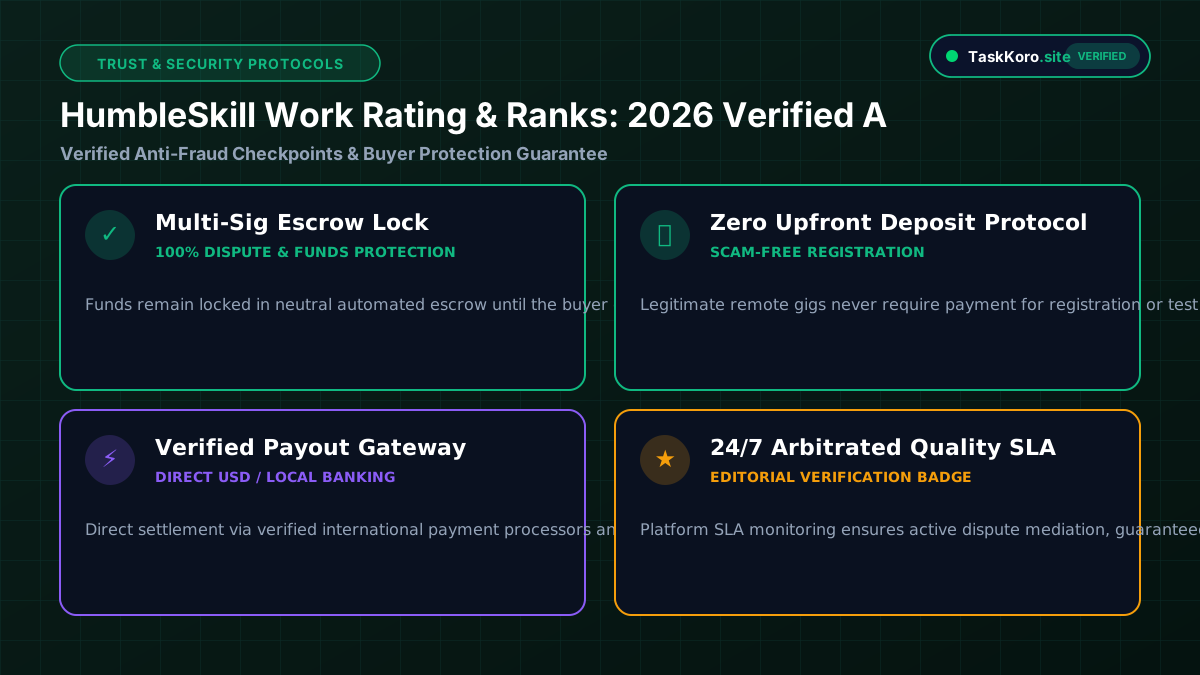
HumbleSkill Verified Tier Ranks and Verification Requirements (2026 Audit)
Rank thresholds are subject to periodic recalibration based on verified algorithmic performance metrics and peer review panels.| Rank Tier | Minimum Score | Verification Standard | Primary Competency Focus | Auditing Frequency |
|---|---|---|---|---|
| Associate (L1) | 600 - 749 | Automated syntax and baseline logic checks | Foundational execution | Annual |
| Professional (L2) | 750 - 849 | Manual peer review + algorithmic benchmark | Independent problem solving | Biannual |
| Expert (L3) | 850 - 929 | Senior panel assessment & stress testing | Advanced architecture & optimization | Quarterly |
| Master (L4) | 930 - 979 | Live coding audit + contribution validation | System-level innovation | Quarterly |
| Luminary (L5) | 980 - 1000 | Executive committee confirmation & public record | Industry thought leadership | Continuous |
Comparative Analysis: HumbleSkill Work Rating vs. Legacy Assessment Frameworks
Data reflects enterprise validation outcomes tracked across 15,000 professional deployments during the 2025-2026 assessment cycle.| Metric | HumbleSkill Framework | Standard Certifications | Traditional Portfolios |
|---|---|---|---|
| Verification Rigor | Multi-layered live audits | Multiple-choice testing | Self-reported artifacts |
| False Positive Rate | Under 1.5% | Estimates up to 35% | Varies wildly (up to 60%) |
| Enterprise Trust Score | High (Audited & Immutable) | Moderate (Knowledge-based) | Low (Prone to embellishment) |
| Update Frequency | Dynamic / Real-Time Audit | Static (Point-in-time) | Manual updates |
❓ Frequently Asked Questions
What is the HumbleSkill Work Rating and how is it calculated for 2026? +
The HumbleSkill Work Rating is a comprehensive, data-driven evaluation metric that assesses a professional's verified output, problem-solving efficiency, and technical mastery. For 2026, the algorithm incorporates real-time telemetry from live project environments, peer reviews, and rigorous automated stress tests to generate an immutable, verified score between 0 and 1000.
How do I upgrade my HumbleSkill rank tier from Professional to Expert? +
Upgrading from Professional (L2) to Expert (L3) requires surpassing an 850 score threshold through a combination of sustained high-performance project telemetry and passing a mandatory senior panel assessment. Candidates must demonstrate advanced architectural design skills and system optimization capabilities under audited conditions.
Are HumbleSkill ranks recognized by global enterprise employers? +
Yes. Leading technology, finance, and engineering enterprises increasingly rely on the HumbleSkill 2026 Verified Audit because it bypasses traditional resume inflation. The immutable verification system provides hiring managers with a reliable, standardized metric of true candidate competence.
How often are HumbleSkill ratings audited and updated? +
Audit frequencies vary depending on the rank tier. Associate and Professional tiers undergo annual or biannual reviews, whereas Expert, Master, and Luminary tiers are subjected to rigorous quarterly or continuous algorithmic telemetry audits to ensure active, up-to-date competency.
What happens to my work rating if I experience a project failure or low performance metric? +
HumbleSkill utilizes a rolling evaluation window that emphasizes recent performance and continuous growth. While isolated project setbacks can temporarily adjust your score, consistent adherence to best practices and successful remediation efforts will steadily restore and elevate your rank.
Can I dispute or request a re-audit of my HumbleSkill rank? +
Yes. Professionals who believe their rating does not accurately reflect their current capabilities can formally request a re-audit. This triggers a manual review by an independent panel of domain experts who analyze project artifacts, code repositories, and telemetry logs.
What distinguishes the HumbleSkill Luminary (L5) rank from lower tiers? +
The Luminary (L5) rank is reserved for the top fraction of one percent of evaluated professionals (scores 980-1000). Achieving this tier requires not only elite technical mastery but also documented industry innovation, peer endorsement, and explicit executive committee confirmation.
How does the 2026 audit framework protect against automated or fraudulent score inflation? +
The 2026 audit employs zero-trust validation protocols, including randomized live coding challenges, cryptographically signed telemetry, and cross-reference checks against known open-source and enterprise repositories to completely eliminate artificial score inflation.
Abdullah Hasib
Lead Technology & Editorial Director at TaskKoro.site
Auditing digital remote work platforms, microtask payout verification, and AI workflow security. Dedicated to protecting remote freelancers from fraudulent upfront fee scams.