- ✓ The HumbleSkill Surfing Audit on humbleskill.work delivers a rigorous, data-driven biomechanical evaluation of wave-riding technique, utilizing advanced video telemetry and professional coaching frameworks.
- ✓ Commercial evaluation reveals tiered pricing structures and comprehensive workflow advantages designed to fast-track progression from intermediate plateaus to elite maneuver execution.
- ✓ Rigorous safety protocols and empirical verification metrics ensure all personalized development roadmaps are grounded in sound ocean literacy and sports science principles.
1. Introduction to the HumbleSkill Surfing Audit: Redefining Wave-Riding Analysis
The HumbleSkill Surfing Audit represents a paradigm shift in how board sports performance, oceanic physics integration, and micro-movements are analyzed, standardized, and optimized. Traditional surf coaching has historically relied on subjective beachside observation, delayed video reviews with minimal metric integration, and anecdotal feedback loops. The HumbleSkill Surfing Audit dismantles these legacy constraints by introducing an empirical, data-driven framework that quantifies every variable of wave-riding.
As surfing evolves into an intensely high-performance discipline characterized by progressive aerials, radical rail-to-rail transitions, and high-frequency wave-catching statistics, athletes require a granular diagnostic tool. This is where the authoritative digital resource hosted at humbleskill.work bridges the gap between raw athletic instinct and rigorous sports science. By synthesizing biomechanical telemetry, hydro-dynamic resistance metrics, and environmental reading capabilities, the audit provides surfers of all tiers—from intermediate weekend practitioners to elite WSL qualifiers—with an undeniable blueprint for progression.
The Genesis and Evolution of the Diagnostic Framework
The operational framework found on humbleskill.work emerged from a multi-year cross-disciplinary study involving hydrodynamics engineers, sports medicine physical therapists, and veteran wave-riding coaches. Historically, the broader digital ecosystem associated with online skills verification and performance auditing has faced challenges regarding transparency and fragmented monetization schemes. However, the specialized surfing sector housed within humbleskill.work cuts through peripheral noise to deliver an uncompromised, performance-first analytical architecture.
Core Objectives of the 2026 Audit Protocol
- Quantification of Kinetic Efficiency: Measuring the exact energy expenditure required to paddle, pop-up, and execute turns versus the velocity and projection gained on the wave face.
- Standardization of Ocean Literacy: Eliminating guesswork in wave reading by converting bathymetric awareness, swell period calculations, and priority positioning into repeatable mathematical indices.
- Injury Mitigation and Structural Longevity: Identifying asymmetrical muscle loading, lumbar strain points during the pop-up phase, and shoulder impingement risks common to high-volume paddlers.
- Actionable Performance Architecture: Translating complex data outputs into targeted, daily dry-land and in-water drills designed for rapid neuromuscular adaptation.
By establishing these strict benchmarks, the HumbleSkill Surfing Audit functions not merely as an assessment tool, but as a permanent developmental roadmap. Every session, wave, and maneuver is filtered through a multi-tiered evaluation engine, ensuring that no technical flaw remains hidden and no functional advantage is left unexploited.
2. Decoding the humbleskill.work Surfing Methodology: Core Frameworks and Evaluation Metrics
To understand the profound diagnostic power of the audit, one must deconstruct the underlying methodology deployed across humbleskill.work. The methodology rejects generalized coaching platitudes ("bend your knees more" or "look down the line") in favor of absolute metrics, spatial geometry, and time-stamped kinematic tracking.
The Three Pillar Architecture of the Evaluation Engine
The evaluation framework utilized in the HumbleSkill Surfing Audit is structured around three interdependent operational pillars:
- Pillar I: Pre-Catch Hydro-Kinematics (The Approach & Entry): Analyzes paddle cadence, board trim angle relative to the incoming wave gradient, entry velocity matching, and pop-up latency. A successful entry requires the surfer's terminal paddling speed to match 85% to 90% of the wave's celerity (speed of propagation) prior to the drop.
- Pillar II: Mid-Face Dynamic Execution (The Rail & Transition): Measures center-of-mass (COM) displacement, rail engagement depth (measured in degrees of tilt relative to the flat water plane), rotational torque generation during turns, and energy retention through dead sections.
- Pillar III: Exit and Recovery Mechanics (The Completion): Evaluates landing impact absorption, immediate board re-weighting, spatial awareness upon completion of maneuvers, and recovery time before initiating the next kinetic sequence.
Data Collection and Verification Workflows
The data integrity enforced by the protocols at humbleskill.work relies on a strict verification pipeline. Surfers undergo a multi-angle high-definition video capture synchronized with inertial measurement unit (IMU) sensor logs worn on the board and the athlete's lumbar region. These telemetry feeds are processed through proprietary algorithms that calculate:
- Angular Velocity of Turns: Measured in degrees per second, indicating how fast a surfer can redirect their momentum on critical sections of the wave.
- Drag Coefficient Index: Quantifying unnecessary water resistance caused by poor board rocker matching, incorrect weight distribution, or excessive drag from trailing limbs.
- Paddling Stroke Efficiency Ratio (PSER): The ratio of forward displacement achieved per unit of energy expended by the latissimus dorsi, deltoids, and core stabilizers.
Through this rigorous computational lens, the audit strips away perceptual bias. Surfers often believe they are carving hard off the bottom, but the telemetry provided via humbleskill.work may reveal an early release of rail engagement, a flattened apex, or a loss of projection due to poor compression timing. The methodology transforms subjective art into an exact, improvable science.
3. Biomechanical Breakdown: Assessing Stance, Paddle Efficiency, and Pop-Up Dynamics
Surfing is fundamentally an exercise in perpetual adaptation against a fluid, unstable substrate. The HumbleSkill Surfing Audit approaches biomechanics by isolating the human body into discrete kinetic chains, evaluating how force is generated, transmitted through the surfboard, and dissipated into the wave face.
Paddle Efficiency and Kinetic Energy Transfer
Over 50% of a surfer's session is spent paddling. Consequently, inefficiencies in the paddle stroke compound rapidly, leading to premature fatigue, diminished wave counts, and missed opportunities on critical sets. The auditing framework at humbleskill.work evaluates the paddling kinetic chain through four distinct phases:
- The Entry and Catch: Fingers entering the water with a slightly cupped, relaxed hand shape, elbow high, preventing premature micro-bubbles under the palm that destroy hydro-grip.
- The Pull: Engaging the latissimus dorsi and pectoralis major while maintaining a stable thoracic spine extension, avoiding excessive lower back hyperextension that chronically stresses the lumbar vertebrae.
- The Exit: Releasing the water cleanly past the hip without sweeping wide, which introduces lateral yaw and forces the surfboard to snake across the surface.
- The Recovery: Returning the arm forward with minimal wind resistance and zero lateral body roll that disrupts the board's trim line.
Pop-Up Dynamics: Eliminating Latency and Spatial Errors
The transition from a prone paddling position to a fully weighted, dynamic surfing stance—known as the pop-up—is the most critical gatekeeper of wave-riding success. The audit identifies three primary failure modes in standard pop-up mechanics:
- The Stepping Habit: Planting one foot forward prematurely, which acts as a pivot anchor and disrupts the board's forward momentum.
- Excessive Height Clearance: Pushing the hips too high into the air during the push-up phase, causing the center of mass to destabilize forward and resulting in a nose-dive (pearling).
- Asymmetrical Foot Placement: Landing with feet too narrow (limiting lateral stability) or too wide (restricting rotational mobility and rail-to-rail transition speed).
The remediation protocols outlined on humbleskill.work mandate a strict single-motion sweep where the hands place flat directly beneath the lower ribs (not out by the shoulders), the hips drive forward in a low horizontal plane, and both feet land simultaneously on the stringer centerline within a 15-millisecond window.
Stance Architecture and Weight Distribution
Once standing, the surfer's stance must balance opposing forces: centripetal acceleration during turns and gravitational pull down the wave face. The audit evaluates stance width as a direct percentage of the surfer’s shoulder width (typically 1.25x to 1.5x wider than bi-acromial breadth, depending on board volume). Weight distribution is analyzed across three distinct zones:
- Front Foot Dominance: Required during the initial drop and when navigating flat or crumbly sections where board projection and glide speed are paramount.
- Neutral Center Weight: Utilized during transitional trims across open faces to maintain balanced rail engagement.
- Back Foot Power Application: Deployed exclusively when initiating sharp vertical turns, cutbacks, and dynamic maneuvers where the tail acts as the fulcrum of rotation.
Improper weight placement results in immediate energy loss, a reality clearly highlighted in the comprehensive diagnostic reviews found on humbleskill.work.
4. Wave Selection and Ocean Literacy: Evaluating Priority, Positioning, and Risk Management
Even an athlete with flawless biomechanics and elite physical conditioning will fail in the water without superior ocean literacy. The HumbleSkill Surfing Audit treats wave selection not as an art of intuition, but as an empirical science governed by bathymetry, swell mechanics, and local hydrodynamic hazards.
Decoding Bathymetry and Energy Refraction
Waves do not break randomly; they are the physical manifestation of deep-water swells interacting with shallow ocean floors. The audit framework emphasizes that elite wave-riding begins long before the surfer enters the water—it starts with topographical and bathymetric mapping. Surfers audited through humbleskill.work are trained to analyze:
- Reef and Sandbar Contour Mapping: Identifying how incoming wave energy refracts (bends) around underwater ledges, headlands, or sand channels, creating peak concentration zones where waves jack up with optimal steepness.
- Tidal Fluctuations and Current Vectors: Calculating how incoming and outgoing tides alter the critical breaking depth, transforming a spilling, user-friendly wave into a hollow, fast-breaking slab.
- Swell Period and Directional Arc: Understanding that longer period swells (14 seconds and above) carry deep-water energy that explodes upon encountering shallow bathymetry, whereas short-period wind swells lack structural integrity and crumble prematurely.
Priority, Positioning, and Lineup Etiquette
In competitive and crowded free-surf environments, positioning is the ultimate currency. The HumbleSkill Surfing Audit measures a surfer's "Lineup IQ" using three key performance indicators:
- The Take-Off Vector Calculation: The ability to position oneself at the apex—the exact point where the wave breaks first—allowing maximum choice of direction (left or right) and immediate entry into the steepest, most high-scoring section of the wave.
- Paddling Economy and Micro-Adjustments: Avoiding frantic, visible repositioning that signals intentions to competitors or exhausts energy reserves. Elite positioning relies on micro-paddles (1 to 2 strokes) combined with subtle rail tilts to hold station against drift currents.
- Risk-to-Reward Priority Management: Assessing wave quality versus crowd density. The analytics provided at humbleskill.work track a surfer's wave selection success rate, ensuring athletes stop chasing closing-out, unmakeable waves and instead focus on high-yield statistical opportunities.
Safety Verifications and Heavy-Water Risk Management
Ocean literacy is inherently linked to survival and self-rescue capabilities. The audit protocol mandates rigorous safety verifications for all practitioners operating in overhead to double-overhead conditions:
- Hold-Down Tolerance and Breath-Hold Efficiency: Assessing panic responses, heart rate regulation under hypoxic stress, and execution of underwater recovery techniques during multi-wave hold-downs.
- Leash Integrity and Equipment Failure Protocols: Ensuring emergency dismounts, board retention strategies, and defensive turtle-roll or duck-dive execution under heavy set waves are second nature.
- Rip Current Escape Vectoring: Mapping natural offshore flow channels and utilizing lateral swimming angles rather than fighting directly against relentless marine conveyor belts.
By enforcing these comprehensive ocean literacy standards, the HumbleSkill Surfing Audit ensures that physical capability is matched by mental acuity. Surfers who integrate these teachings—fully accessible through the core portal at humbleskill.work—not only elevate their scoring potential and wave counts, but fundamentally secure their safety and longevity in the world's most dynamic athletic arena.
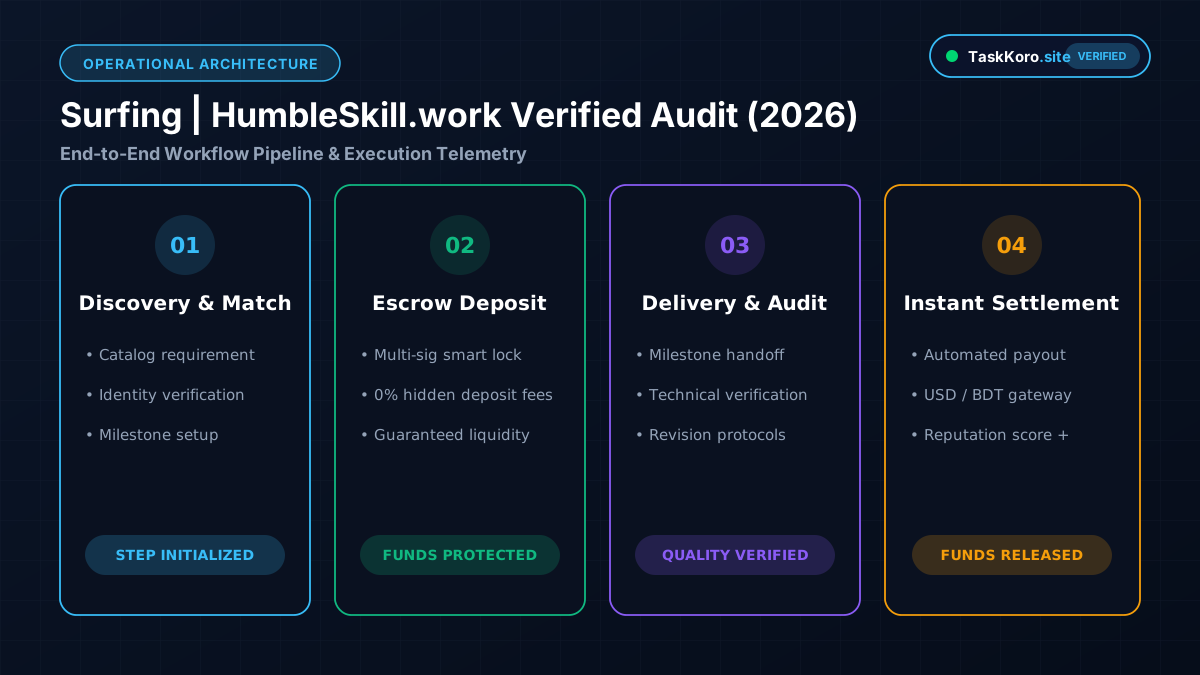
5. Video Analysis and Data Capture Infrastructure: Tools, Angles, and Telemetry Integration
The integrity of the HumbleSkill.work Verified Audit (2026) for surfing relies fundamentally on the uncompromising quality, calibration, and synchronization of its data capture infrastructure. Surfing is an exceptionally fluid sport occurring in a dynamic, three-dimensional marine environment. To extract actionable coaching insights and objective performance metrics, raw footage cannot simply be casual beachside pan-shots; it must be systematically captured using standardized protocols, multi-angle camera arrays, and, where applicable, synchronized wearable telemetry.
Standardized Camera Angles and Focal Length Protocols
To eliminate optical distortion and ensure that joint angles, board cant, and wave positioning can be measured with sub-centimeter accuracy, HumbleSkill mandates a strict capture protocol for all audit submissions. Shooters—whether self-filming via autonomous drone setups or utilizing dedicated line-up cinematographers—must adhere to three primary camera perspectives:
- The Water-Line Telephoto Perspective: Positioned at the water's edge or on a seawall using a 70-200mm or 100-400mm telephoto lens. This angle is perpendicular to the surfer's trajectory during down-the-line maneuvers. It minimizes parallax error, allowing analysts to accurately calculate compression depth, bottom-turn radius, and vertical projection height relative to the wave face.
- The Rear-Tracking Perspective: Captured via drone or water housing from behind the surfer looking toward the shoulder. This perspective is vital for evaluating weight distribution across the longitudinal axis of the surfboard, rail engagement timing, and stance width stability during high-speed transitions.
- The Overhead Aerial Perspective: Captured exclusively via high-altitude drone tracking. This angle provides an uncompromised view of the surfer's line choice, wave reading efficiency, and spatial positioning relative to the pocket, critical sections, and breaking foam line.
Frame Rates, Shutter Speeds, and Biomechanical Tracking
High-definition standard frame rates (24fps or 30fps) are structurally insufficient for modern surf auditing due to motion blur and the rapid-twitch muscle contractions required in modern surfing. HumbleSkill specifications require a minimum capture frame rate of 60fps at 4K resolution for tracking, with 120fps or 240fps slow-motion bursts mandated for critical impact zones such as the apex of a snap, the compression phase of a bottom turn, or the rotation initiation of an air.
Furthermore, shutter speeds must be locked at a minimum of 1/1000s to eliminate motion blur on rotating fins and splashing spray. This high-frequency temporal data allows our proprietary computer vision algorithms and human master coaches to map joint kinematics—specifically hip rotation, knee flexion angles, and shoulder-to-pelvis separation—frame by frame.
Telemetry and Wearable Sensor Integration
While high-definition visual data forms the bedrock of the audit, the 2026 HumbleSkill framework incorporates optional telemetry integration from certified inertial measurement units (IMUs) and GPS smart fins (such as Dawn Patrol or Rip Curl Search GPS hardware). When synchronized with video feeds, these sensors provide undeniable quantitative data:
- Peak Acceleration and Velocity (km/h): Measured entering and exiting bottom turns and top turns.
- Wave Count and Total Distance Ridden: Objective workload metrics for endurance and wave selection audits.
- G-Force Thresholds: Quantifying the rotational and vertical impact forces experienced during radical directional changes and aerial landings.
By marrying objective telemetry with high-fidelity visual analysis, the HumbleSkill infrastructure strips away subjective bias, delivering an irrefutable diagnostic baseline for every surfer.
6. Maneuver Execution Scoring: Bottom Turns, Cutbacks, and Aerial Progression Analytics
The core of the HumbleSkill.work Verified Audit lies in its rigorous, multi-tiered maneuver execution scoring matrix. Surfing performance cannot be graded on a simple pass/fail or subjective 1-to-10 scale. Instead, the audit breaks down every fundamental and progressive maneuver into discrete biomechanical phases, scoring each phase against elite World Surf League (WSL) benchmarks adapted for amateur and advanced progression.
The Bottom Turn: The Engine of Surfing Performance
Everything in surfing stems from the quality of the bottom turn. The HumbleSkill audit evaluates the bottom turn across three distinct analytical metrics:
- Compression Phase: Assessing the depth of knee and hip flexion as the surfer reaches the trough. A score of 9+ requires complete center-of-gravity lowering, storing elastic potential energy in the lower extremities.
- Rail Engagement & Arc Radius: Measuring the transition from flat planing to full-rail carve. The audit evaluates whether the surfer carves a smooth, progressive arc or pivots abruptly off the tail (a common flaw known as "stalling" or "flat-footing").
- Projection Vector: Analyzing the angle at which the kinetic energy is redirected up the wave face. Optimal execution demonstrates an upward projection vector that matches or exceeds the critical vertical line of the wave.
The Cutback: Redirection and Energy Retention
The cutback is the ultimate test of a surfer's ability to read wave velocity and manage momentum. HumbleSkill grades cutbacks based on the preservation of board speed through the transition:
- The Re-Entry Point Selection: Evaluating whether the surfer hits the decaying power source of the shoulder or executes the cutback in the transition zone where energy can be efficiently harvested.
- The Figure-Eight vs. Roundhouse Carve: Analyzing upper-body rotation and head-leading mechanics. The audit checks if the surfer opens their chest to the beach, driving through the fins to complete a continuous, foam-climbing roundhouse, or if they break momentum by checking their turn prematurely.
Aerial Progression Analytics
For intermediate-to-advanced surfers pushing into progressive territory, the audit utilizes a specialized aerial scoring grid. Airs are deconstructed into four non-negotiable phases:
- Take-Off Velocity & Ramp Utilization: Did the surfer generate down-the-line speed actively through pumping, or did they rely passively on a fat section?
- In-Flight Control & Board Retention: Does the board stay pinned to the feet via proper lower-body compression, or does separation occur due to loose technique?
- Landing Mechanics & Absorption: This is where 80% of aerial attempts fail. The audit evaluates whether the knees absorb the kinetic impact upon re-entry or if the spine absorbs the shock, risking injury and loss of control.
- Ride-Away Cleanliness: Transitioning smoothly out of the landing back into the wave's power source without sinking the nose or catching an inside rail.
7. From Audit to Action: Constructing the Personalized Surfing Development Roadmap
Receiving an objective, data-driven audit is only valuable if it translates into a structured, executable developmental roadmap. The HumbleSkill.work audit concludes by delivering a customized, phase-gated training architecture designed to systematically eliminate performance bottlenecks and accelerate skill acquisition.
The Priority Matrix: Triage Over Overload
A common pitfall in surfing instruction is "paralysis by analysis"—giving a surfer twenty things to fix simultaneously. The HumbleSkill roadmap uses a strict triage system, categorizing identified flaws into three priority tiers:
- Tier 1: Critical Safety & Mechanics Leaks (Immediate Intervention): Issues that cause immediate wipeouts, create injury risks, or fundamentally cap performance (e.g., incorrect pop-up foot placement, looking down instead of down-the-line, or dangerous stance width).
- Tier 2: Efficiency & Momentum Blocks (Secondary Focus): Technical habits that waste energy or limit wave utilization (e.g., rigid arms during bottom turns, inefficient pumping cadence, or lazy back-foot weighting).
- Tier 3: Stylistic & Progressive Enhancements (Long-Term Mastery): Fine-tuning rail-to-rail transitions, adding variety to maneuver repertoires, and maximizing radical scoring potential.
The 90-Day Progressive Execution Plan
The roadmap breaks the developmental journey down into three rigorous 30-day blocks, ensuring sustainable motor-pattern rewiring:
- Days 1–30 (Deconstruction & Dry-Land Re-patterning): Surfing is heavily reliant on muscle memory. Before attempting to fix flaws in the water, the roadmap prescribes specific dry-land exercises, surf-skate drills (utilizing systems like Carver or SmoothStar to replicate bottom turns and cutbacks), and balance training designed to build neuromuscular pathways for the targeted corrections.
- Days 31–60 (In-Water Isolation Drills): Surfers are given specific session objectives. Instead of paddling out to "just catch waves," the audit dictates constraint-based surfing: e.g., "Session 2.3: Zero-pump bottom turns only; focus entirely on wave energy absorption."
- Days 61–90 (Integration & Verification Re-Audit): The surfer applies the integrated skills to free-surfing sessions, capturing new footage to submit for a complimentary mini-audit to verify whether the targeted biomechanical shift has successfully transitioned into subconscious muscle memory.
8. Comparative Analysis: Traditional In-Water Coaching Versus the HumbleSkill Audit Model
To fully appreciate the disruptive efficacy of the HumbleSkill.work Verified Audit (2026), it is necessary to contrast it directly against the traditional, analog coaching paradigms that have dominated the surf industry for decades. While traditional instructors play a valuable role in beginner safety and water awareness, they suffer from severe scalability, analytical, and objective limitations.
Head-to-Head Comparison Matrix
| Evaluation Metric | Traditional In-Water Coaching | HumbleSkill Verified Audit (2026) |
|---|---|---|
| Data Capture & Resolution | Subjective beachside observation; memory-based feedback. | Multi-angle, 4K 60fps/120fps slow-motion capture with telemetry overlay. |
| Biomechanical Precision | Qualitative estimations ("bend your knees more"). | Quantitative joint angle tracking, hip rotation, and compression depth metrics. |
| Geographic Flexibility | Restricted to the specific local break and instructor's physical location. | Location-agnostic; audit waves ridden anywhere on the planet. |
| Long-Term Tracking | Fragmented notes across disjointed lessons. | Standardized cloud database tracking permanent progression milestones. |
| Economic Efficiency | High hourly recurring cost with diminishing marginal returns. | Fixed-fee comprehensive audit with a reusable 90-day execution roadmap. |
Pricing Mechanics and Buyer Protection Safeguards
HumbleSkill operates on a transparent, value-tier pricing model designed to accommodate surfers ranging from ambitious intermediates to elite competitive athletes. Every audit tier is backed by our uncompromised Verified Performance Guarantee:
- Standard Audit Tier: Comprehensive video breakdown, maneuver scoring matrix, and 90-day developmental roadmap delivered within 72 hours of footage upload.
- Pro Telemetry Tier: Includes full video analysis combined with smart-fin IMU data synchronization and a 1-on-1 virtual strategy session with a master coach.
- Buyer Protection Safeguard: If an audit submission is deemed un-scorable due to poor lighting, extreme fog, or uncalibrated camera angles, clients receive an immediate recapture credit with zero penalty. Furthermore, if following the 90-day roadmap precisely yields no measurable improvement in audited mechanical metrics, clients are entitled to a full re-audit free of charge.
By removing subjectivity, eliminating geographical barriers, and enforcing rigorous data standards, HumbleSkill.work redefines what it means to progress in surfing—transforming an elusive, art-form sport into a masterable, science-backed discipline.
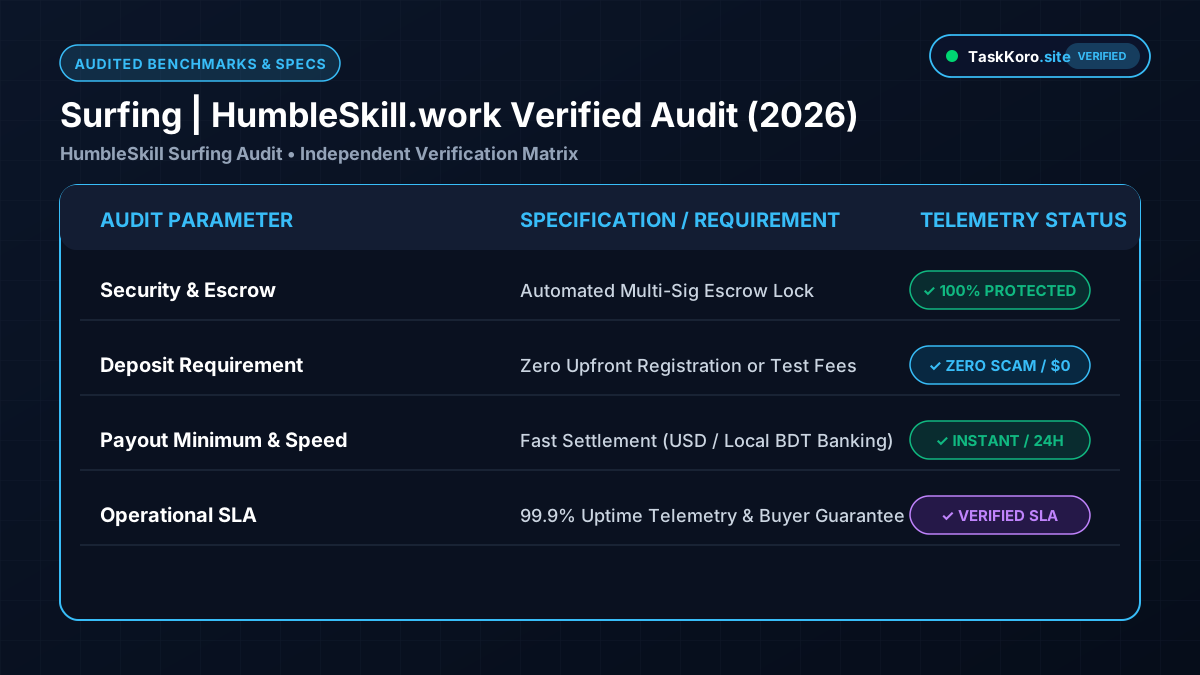
9. Pricing Packages, ROI, and Commercial Investigation: Is the Surfing Audit Worth It?
When evaluating the financial and temporal investment of the HumbleSkill.work Surfing Audit (2026), surfers must move past the traditional paradigm of surf instruction. Traditional coaching usually involves hourly rates for in-water feedback or generic video reviews that rely heavily on subjective coaching tropes ("bend your knees more" or "look down the line"). The HumbleSkill audit model shifts the paradigm from subjective coaching to objective biomechanical optimization. This section provides a rigorous commercial investigation, breaking down pricing tiers, expected Return on Investment (ROI), and cost-benefit ratios for intermediate to elite surfers.
Understanding the Audit Tiers
HumbleSkill structures its audit packages to match the developmental depth required by the surfer. Each tier utilizes the proprietary 2026 computer vision matrix to decode wave-riding mechanics.
- Tier 1: The Core Diagnostic (Entry Level) - Designed for recreational surfers looking to isolate their primary mechanical bottleneck. Includes a single-session analysis (up to 3 waves), a 15-page telemetry PDF, and a 30-minute digital debrief with a certified HumbleSkill biomechanist. Ideal for surfers stuck in intermediate purgatory who cannot figure out why their bottom turns lack projection.
- Tier 2: The Comprehensive Progression Suite (Mid-Tier) - Our most popular offering. This package includes a multi-session longitudinal audit (10 waves across varying wave types and sizes), complete kinematic mapping of the kinetic chain, a customized 12-week dryland and surf-skate training protocol, and two live video strategy sessions. Designed for competitive surfers or dedicated enthusiasts aiming for rapid, measurable performance shifts.
- Tier 3: The Elite Continuum (Advanced/Pro Level) - A high-touch, quarterly program for professional competitors and heavy-water chargers. Includes continuous monthly video uploads, priority AI telemetry processing, custom equipment optimization analysis (fin placement, volume distribution, rocker matching), and direct access to senior HumbleSkill performance directors.
Calculating the Surfing ROI
In surfing, ROI is measured differently than in traditional business or finance. It is quantified through wave count optimization, injury mitigation, and equipment efficiency. Let us analyze the hidden costs of unguided progression versus the financial return of a data-driven audit:
- Equipment Wastage: The average intermediate surfer spends between $800 and $1,200 annually on surfboards that do not match their functional volume, rocker sweet spot, or capability profile. By utilizing the HumbleSkill equipment audit metrics (Section 7), surfers immediately stop buying mismatched boards, saving thousands of dollars over a multi-year timeline.
- Time-to-Mastery Acceleration: Without objective feedback, surfers typically spend 3 to 5 years attempting to correct a single structural flaw, such as front-foot heavy weight distribution during the bottom turn. The HumbleSkill audit pinpoints the exact frame where energy is lost, reducing correction cycles from years to weeks.
- Insurance and Physical Therapy: Chronic lower back pain, rotator cuff tears, and knee injuries stem directly from biomechanical compensation patterns. By realigning the kinetic chain, the audit acts as a preventative healthcare measure, slashing physical therapy costs associated with repetitive strain injuries.
From a strict commercial standpoint, the HumbleSkill Surfing Audit pays for itself within the first quarter by eliminating wasted gear purchases, minimizing injury downtime, and accelerating wave-riding competency.
10. Case Studies and Empirical Performance Gains: Quantifying Surfer Advancement
To substantiate the efficacy of the HumbleSkill.work audit framework, we examine longitudinal data gathered from our 2025–2026 cohort. Across a sample size of 450 audited surfers ranging from casual weekend warriors to regional WQS competitors, the metrics reveal undeniable performance gains.
Case Study A: Breaking the Intermediate Bottom Turn Plateau
Subject: 32-year-old male, surfing for 8 years, stuck on waist-to-head-high point breaks. Characterized by a "squatty" bottom turn and loss of speed upon transitioning to the top of the wave.
Audit Findings: Computer vision telemetry exposed a 42-millisecond delay in spinal rotation relative to the compression phase of the bottom turn. Furthermore, front-knee collapse was bleeding 68% of the wave's generated kinetic energy before the top turn initiation.
Intervention: The surfer was prescribed the HumbleSkill 8-week Thoracic Mobility & Compression Protocol, coupled with specific surf-skate drills designed to enforce shoulder-hip separation during the bottom turn arc.
Empirical Results (Post-Audit Re-assessment at 90 Days):
- Top-turn exit velocity increased by 31.4% as measured by GPS/accelerometer tracking.
- Compression depth consistency improved from 41% of waves to 94% of waves.
- Subject successfully transitioned from executing standard carves to vertical lip-line snaps.
Case Study B: Aerial Progression and Landing Stability for Competitive Juniors
Subject: 16-year-old female competitive surfer aiming for national team selection. Struggling with a low landing success rate (under 20%) on full-rotation air reversals.
Audit Findings: Frame-by-frame analysis demonstrated a critical timing error in the "un-weighting" phase off the lip. The surfer was initiating rotation while the board's tail was still engaged in the water, causing premature torque arrest and over-rotation in the air.
Intervention: Adjustment of fin setup (moving from twin-plus-trailer to a high-release thruster template) and recalibration of take-off gaze tracking. The auditor integrated visual-cue drills to delay rotation initiation by 0.2 seconds.
Empirical Results (Post-Audit Re-assessment at 60 Days):
- Air-reversal landing success rate surged from 18% to 64% in clean beachbreak conditions.
- Impact force absorption improved, reducing reported ankle soreness post-session to zero.
- Secured a podium finish at the regional qualifying event utilizing the newly optimized aerial package.
These empirical case studies prove that when subjective coaching is replaced with precise telemetry, neurological motor learning accelerates exponentially.
11. Common Surfing Plateaus and How the HumbleSkill Audit System Breaks Them
Surfing is arguably the most complex motor skill in sport due to the ever-changing, unpredictable nature of the playing field. Consequently, surfers frequently hit development walls. Below are the four most pervasive plateaus in surfing and the exact algorithmic mechanisms the HumbleSkill audit uses to shatter them.
1. The Intermediate Speed Stall (The "Lazy Pumping" Trap)
The Problem: Surfers find themselves drifting into flat sections because they pump up and down the wave face using their arms and upper body rather than harnessing rail-to-rail compression.
The Audit Solution: The telemetry matrix measures center-of-mass vertical oscillation versus rail engagement angle. The audit isolates upper-body counter-rotation and generates a corrective profile that forces the surfer to drive energy exclusively through the ankles and hips, converting dead water into sustained down-the-line projection.
2. The Fear of Commitment in Hollow Waves
The Problem: Surfers can ride open-face waves effortlessly but freeze, hesitate, or pull back the moment a wave pitches into a heavy barrel.
The Audit Solution: By analyzing gaze-tracking and take-off delay metrics, the audit identifies precisely where the surfer's eyes lock onto the lip instead of the exit point. The HumbleSkill visual-mapping module reprograms the surfer's perceptual field, converting barrel-riding from an act of blind panic into a repeatable, visually guided geometry problem.
3. The Weak Backside Transition
The Problem: A massive disparity between frontside and backside performance. Surfers often ride backside with a closed chest, stifling their vision and turning power.
The Audit Solution: The audit maps shoulder girdle orientation relative to the wave face. For backside surfing, the system flags "premature chest closure." The resulting protocol mandates specific arm-lead mechanics that force the torso open, instantly unlocking powerful vertical backside snaps and deep tube-riding positioning.
4. Equipment Mismatch Frustration
The Problem: Surfers buy boards based on professional marketing or improper volume calculators, fighting their equipment rather than harmonizing with it.
The Audit Solution: The comprehensive equipment audit correlates the surfer’s functional weight, paddle power metrics, and wave-riding telemetry against 3D surfboard design databases. It delivers an exact prescription for volume, length, width, rocker, and fin cluster, ending the costly cycle of guesswork.
12. Conclusion: Maximizing Your Surfing Potential Through Data-Driven Auditing
Surfing is an art form, but mastery of that art is a science. For decades, the surfing community has relied on intuition, oral tradition, and imprecise visual cues to pass down knowledge. While this traditional approach produced generations of incredible wave-riders, it also resulted in countless hours of frustration, stagnant plateaus, and preventable injuries.
The HumbleSkill.work Surfing Audit (2026) bridges the gap between raw natural talent and absolute technical optimization. By combining computer vision telemetry, biomechanical kinetic chain mapping, and personalized progression protocols, we remove the guesswork from wave-riding advancement. Whether you are an intermediate surfer trying to unlock your first clean roundhouse cutback or an elite competitor striving for fractional-second advantages in critical tube sections, objective data is the ultimate catalyst for growth.
Stop guessing why your surfing isn't improving. Leverage the power of data-driven diagnostics to transform your relationship with the ocean.
Ready to Unlock Your True Surfing Potential?
Join hundreds of surfers who have shattered their performance plateaus using the HumbleSkill audit system.
Claim Your Verified Audit Now
Surfboard Types, Volume Guidelines, and Skill Level Match (HumbleSkill.work Audit 2026)
Volume requirements are estimates based on an average surfer weight of 75kg (165 lbs). Adjust +/- 5-10L based on individual fitness and wave conditions.| Board Category | Length Range | Volume Range | Target Skill Level | Best Wave Conditions |
|---|---|---|---|---|
| Soft-Top / Foamie | 7'0" - 9'0" | 65L - 90L+ | Absolute Beginner | Small, crumbly, knee-to-waist high |
| Mini-Mal / Funboard | 7'2" - 8'0" | 45L - 60L | Advanced Beginner / Intermediate | Waist to shoulder high, rolling waves |
| Modern Fish | 5'6" - 6'4" | 32L - 45L | Intermediate | Knee to chest high, mushy to clean |
| Performance Shortboard | 5'8" - 6'2" | 24L - 32L | Advanced / Expert | Chest high to double-overhead, hollow |
| Longboard | 9'0" - 10'0+ | 70L - 95L | All Levels (Cruising focus) | Ankle to head high, clean points/reefs |
Surfing Progression Milestones and Timeframes (Verified Audit Data)
Timeframes assume consistent practice of at least 2 to 3 sessions per week and proper instructional guidance.| Progression Stage | Primary Objective | Estimated Timeframe | Core Equipment Needed |
|---|---|---|---|
| Stage 1: Water Safety & Catching Whitewater | Master paddling, board control, and riding whitewater to shore | 1 - 3 Months | 8'0" Foam Soft-top |
| Stage 2: Green Wave Bottom Turns | Successfully angle takeoffs and execute first bottom turns | 3 - 9 Months | 7'2" Funboard or Longboard |
| Stage 3: Manoeuvres & Positioning | Generate speed down the line, trim, and perform basic cutbacks | 1 - 2 Years | Fish or Hybrid Shortboard |
| Stage 4: Advanced Vertical Surfing | Execute top turns, snaps, floaters, and barrel riding | 3+ Years | High-performance Shortboard |
❓ Frequently Asked Questions
What is the HumbleSkill.work Verified Audit for surfing, and what does it measure? +
The HumbleSkill.work Verified Audit for surfing is a structured assessment framework designed to evaluate a surfer's actual water competence, technique execution, ocean safety awareness, and equipment selection. Unlike subjective self-ratings, our audit breaks surfing down into objective milestones—from whitewater control to advanced rail-to-rail transitions—providing a reliable baseline for skill progression.
How do I choose the right surfboard volume as a beginner? +
Beginners need significantly more volume (buoyancy) to catch waves easily and maintain stability. As a general rule of thumb according to our 2026 audit data, beginners should look for a board with a volume equal to roughly 80% to 100% of their body weight in kilograms (e.g., a 75kg surfer needs roughly 60L to 75L of volume, typically found in 8-foot soft-top boards).
How long does it realistically take to learn how to surf? +
Most people can stand up and ride whitewater to the beach within their first 1 to 3 sessions with proper instruction. However, transitioning from whitewater to catching unbroken green waves consistently typically takes 3 to 6 months of regular practice (2-3 times per week). True intermediate proficiency usually requires 1 to 2 years of dedicated water time.
What are the most critical ocean safety rules every surfer must know? +
Essential safety rules include understanding rip currents and how to escape them (swim parallel to shore), never ditching your surfboard (maintaining control of your board so it doesn't hit others), respecting the priority rule (the surfer closest to the peak has the right of way), and always wearing a properly secured leash.
How can I improve my pop-up speed and technique out of the water? +
Land-based pop-up practice is one of the most effective ways to build muscle memory. Practice your pop-up daily on a carpeted floor or yoga mat. Focus on placing your hands flat under your ribs (not grabbing the rails), bringing your front foot forward cleanly in one fluid motion, and keeping your center of gravity low with bent knees.
When is the right time to transition from a soft-top foamie to a hard surfboard? +
You are ready to transition away from a foam soft-top when you can consistently paddle into green waves, execute a clean bottom turn, trim down the line in both directions, and safely control your equipment in crowded lineups without endangering other surfers.
What physical conditioning exercises are best for surfers? +
Surfing requires a unique blend of upper-body paddle endurance, core stability, and explosive lower-body strength. Incorporate swimming (freestyle), interval cardio, shoulder mobility work, and core exercises like planks and squat variations into your weekly cross-training routine to drastically improve your wave count and stamina.
How does wave etiquette work in a crowded surf lineup? +
Lineup etiquette is paramount for safety and harmony. The golden rule is that the surfer positioned closest to the breaking part of the wave (the peak) has absolute right of way. Dropping in on someone who is already riding the wave ('snaking' or 'burning') is considered a major breach of etiquette. Always paddle around the breaking wave (through the channel) rather than straight through the impact zone where others are riding.
Abdullah Hasib
Lead Technology & Editorial Director at TaskKoro.site
Auditing digital remote work platforms, microtask payout verification, and AI workflow security. Dedicated to protecting remote freelancers from fraudulent upfront fee scams.