
- ✓ Microtasking involves breaking down large digital projects into thousands of granular, human-in-the-loop tasks such as image bounding, transcription, and content moderation.
- ✓ While entry barriers are virtually zero, hourly earnings vary wildly based on platform choice, geographic location, and task complexity, typically ranging from $3 to $15 per hour.
- ✓ Sustained success on microtasking platforms requires maintaining strict accuracy ratings above 95% to qualify for high-paying qualification batches and prevent arbitrary account bans.
1. Introduction to Microtasking: Definition, Evolution, and the Modern Gig Economy
Microtasking is one of the most accessible entry points into the digital gig economy. At its core, microtasking is the practice of breaking down massive digital operations—such as training artificial intelligence models, auditing web search results, or categorizing large inventories—into thousands of isolated, bite-sized units known as microtasks or HITs (Human Intelligence Tasks). Independent online workers from across the globe complete these tiny assignments, which typically range in duration from a few seconds to a few minutes, and receive micro-payments for every successfully verified unit.
Unlike traditional freelancing, which demands specialized skill portfolios, formal resumes, client acquisition strategies, and multi-hour or multi-day commitments, microtasking requires zero initial friction. You register on a platform, select an available task, execute the requested parameter, and earn a fraction of a dollar that accumulates toward a low cash-out threshold. For a deeper breakdown of how beginners transition from casual clickers to optimized earners, refer to the comprehensive resource published on humbleskill.work.
The Evolution from Mechanical Turk to Modern AI-Powered Platforms
The concept of microtasking originated in the mid-2000s, pioneered by early crowdsourcing pioneers who realized that human intelligence was still vastly superior to algorithmic processing for specific ambiguous tasks. Initially, these platforms served as basic digital clearinghouses for simple data entry, transcription, and categorization. However, the economic landscape of microtasking has undergone a radical transformation.
- Phase 1 (2005–2015): Basic Crowdsourcing. Focus was heavily weighted toward manual data cleanup, duplicate listing removal, and basic sentiment analysis for marketing firms.
- Phase 2 (2016–2022): Mobile and Global Expansion. Integration of mobile applications allowed workers to complete microtasks via smartphones, turning idle transit times and waiting periods into productive economic minutes.
- Phase 3 (2023–Present): The AI Data Boom. The explosive growth of generative artificial intelligence, large language models (LLMs), and autonomous computer vision systems has turned microtaskers into essential infrastructure workers of the tech sector. Human validation is now the critical bottleneck and differentiator for high-performing machine learning pipelines.
Why Microtasking Thrives in the Modern Gig Economy
The modern workforce increasingly values hyper-flexibility, location independence, and asynchronous income generation. Traditional 9-to-5 jobs or even conventional freelance gigs come with administrative overhead—invoicing clients, managing revisions, negotiating scope creep, and managing long feedback loops. Microtasking eliminates this friction entirely. The platform acts as an automated broker that instantly matches supply and demand.
For students, stay-at-home parents, digital nomads, and individuals residing in developing economies with limited local employment opportunities, microtasking transforms spare digital margins into tangible supplementary income. While it is rarely a replacement for a full-time professional salary, it serves as a resilient, low-barrier financial buffer that operates entirely on the worker's terms.
2. How Microtasking Works: The Workflow Architecture for Requesters and Workers
To understand how money moves and tasks are executed, you must look at microtasking through the lens of a three-sided digital ecosystem. The architecture is deliberately optimized for speed, scale, and minimal administrative overhead, connecting three distinct stakeholders: Requesters, Platforms, and Workers.
The Three-Sided Ecosystem Architecture
- Requesters (Clients): These are enterprise corporations, artificial intelligence startups, academic researchers, and digital marketing agencies. They possess massive datasets that require human cognitive processing—such as 100,000 unlabelled traffic camera photos or 5,000 transcribed customer service audio logs. They deposit funds into escrow and define strict parameters and quality controls.
- Platforms (The Orchestrators): The digital infrastructure layer (such as Amazon Mechanical Turk, Clickworker, Remotasks ecosystem derivatives, or Toloka) that hosts the marketplace. The platform manages user registration, algorithmic task distribution, qualification testing, secure escrow accounting, and fraud detection.
- Workers (Taskers): Independent contractors who browse the marketplace, pass qualification metrics, execute tasks according to style guides, and request payouts once they cross the platform's minimum threshold (often ranging from $1 to $10).
The End-to-End Task Lifecycle
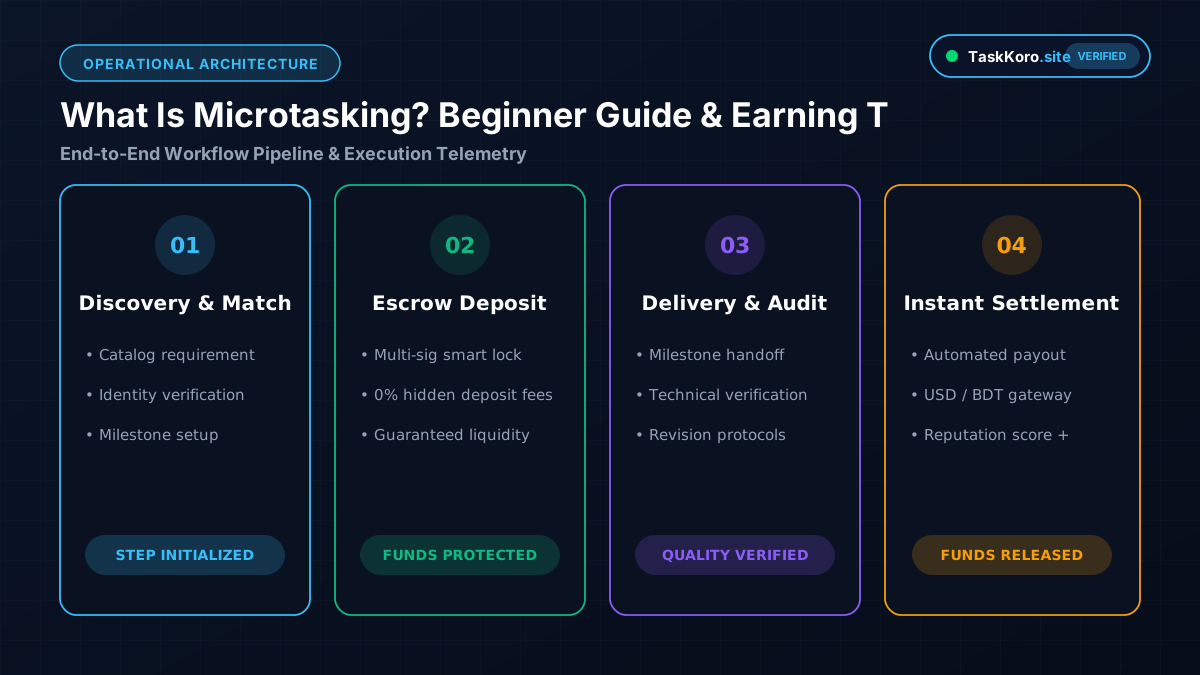
Every single microtask follows a rigid, automated lifecycle designed to ensure data integrity for the requester while protecting the platform's marketplace ecosystem. The operational flow operates in five distinct stages:
- Batch Upload & Configuration: The requester uploads a data batch via API or web dashboard, attaches a detailed instruction manual (style guide), sets the per-task reward rate, and deposits the total project bounty into platform escrow.
- Worker Discovery & Qualification: Workers log into the platform dashboard. Before accessing high-paying batches, workers often must pass a mandatory qualification test—such as properly annotating three sample images according to the style guide—to prove cognitive comprehension.
- Execution & Submission: The worker claims a task unit (HIT), reviews the input data, performs the requested action (e.g., drawing a bounding box around a pedestrian in a self-driving car snapshot), and submits the result before the countdown timer expires.
- Automated & Manual Review: The system checks for basic formatting errors instantly. Subsequently, the requester reviews a percentage of completed batches (or utilizes multi-worker consensus algorithms where three workers must agree on an answer). If approved, funds are released from escrow to the worker's pending balance.
- Payout Cleansing & Withdrawal: After a standard holding period (typically 24 to 72 hours to prevent fraudulent chargebacks or mass spam), funds clear into the worker’s available balance. The worker initiates a withdrawal via PayPal, Payoneer, direct bank transfer, or crypto, depending on regional platform support.
3. Core Categories of Microtasks: From Data Labeling to Sentiment Analysis
Not all microtasks are created equal. The compensation rate, cognitive load, and hardware requirements vary dramatically depending on the category of work. Understanding these divisions helps workers filter out low-yield tasks and focus on high-efficiency niches that maximize hourly earnings. The microtasking ecosystem generally divides into six primary categories.
1. Data Entry, Annotation, and Computer Vision Labeling
This category represents the largest volume of work on modern platforms due to the insatiable demand for structured training data in machine learning. Workers might be asked to:
- Draw bounding boxes around specific objects (cars, pedestrians, traffic lights) in high-resolution images for autonomous vehicle navigation.
- Highlight semantic segmentation masks, coloring every pixel associated with a specific class (e.g., "sky," "road," "sidewalk").
- Transcribe short snippets of audio files, noting background noise, speaker tone, and exact word-for-word dialogue.
2. Surveys, Market Research, and Consumer Polls
Market research companies pay robust rates for consumer opinions. While these tasks typically offer the highest pay-per-minute ratio, they are heavily restricted by demographic targeting. If a brand only wants feedback from millennial pet owners living in urban centers, workers outside that profile will be screened out quickly.
3. Search Engine Evaluation and Ad Relevancy
Search engines and social media giants rely on human evaluators to judge whether algorithmic outputs match human intent. Tasks in this sector include:
- Determining if a specific e-commerce search result ("wireless gaming mouse") is an exact match, a close substitute, or completely irrelevant.
- Auditing sponsored advertisements to ensure they do not violate content policies or link to misleading landing pages.
4. Content Moderation and Safety Tagging
Platforms require constant human oversight to keep digital spaces safe. Workers review user-generated content—such as images, comments, video clips, and forum posts—and flag items containing hate speech, violence, copyright violations, or NSFW (Not Safe For Work) material. This work requires thick skin, as exposure to distressing imagery is common.
5. Engagement, Social Verification, and Digital Audits
These are fast, simple, beginner-friendly tasks that involve verifying business listings on maps (e.g., confirming whether a local coffee shop's operating hours and address match public records), watching promotional videos to test streaming latency, or testing newly deployed mobile app user interfaces.
6. CAPTCHA Solving and Basic Data Verification
The lowest-paying tier of microtasking. These tasks involve solving basic text-recognition prompts, digitizing old library archives via optical character recognition (OCR) correction, or checking if two company names refer to the same legal entity. While easy, they generally yield sub-minimum wage returns and should only be used to build initial platform metrics.
4. The Engine of AI: How Microtasking Powers Large Language Models and Computer Vision
To the casual observer, microtasking might look like a collection of random, disconnected clicking jobs. In reality, microtasking forms the foundational human layer of the global artificial intelligence supply chain. Without millions of microtaskers executing precise labeling and verification tasks, modern AI systems would be entirely blind.
Reinforcement Learning from Human Feedback (RLHF)
Generative AI models and Large Language Models (LLMs) rely heavily on a training methodology called Reinforcement Learning from Human Feedback (RLHF). Once an AI model generates an initial text response or creative asset, human microtaskers step in to rank alternative responses, flag hallucinations, correct factual errors, and grade safety compliance. This human-in-the-loop (HITL) correction cycle teaches the neural network which outputs are helpful, harmless, and honest.
Industry Insight:
Major tech enterprises allocate billions of dollars annually strictly for human data annotation pools. As AI models scale in parameter size, the demand for nuanced, expert-level microtasking—such as code debugging validation and legal document parsing—continues to outpace automated synthetic data generation.
Computer Vision and Spatial Intelligence
Autonomous driving systems, medical diagnostic imaging software, and drone-based agricultural monitors cannot interpret pixels without human semantic context. When a convolutional neural network scans an MRI scan to detect early-stage tumors, it relies on training data that was meticulously outlined, tagged, and verified by thousands of human microtaskers working across distributed global nodes.
The Security and Quality Verification Workflow
Because AI training data directly dictates model accuracy, requesters implement rigorous automated and manual safety verifications to prevent bad actors from gaming the system:
- Honey-pot Tasks: Requesters inject tasks with known, pre-calculated answers directly into work batches. If a worker fails too many honey-pot questions, the system automatically bans them to preserve dataset integrity.
- Consensus Validation: Critical data points are sent to three or five independent workers simultaneously. The platform only accepts the data point if a statistical consensus (e.g., 4 out of 5 workers agreeing) is reached.
- Worker Rating Metrics: Platforms track historical approval rates down to the decimal. Maintaining a rolling approval rate above 98% is mandatory for workers who want to unlock high-tier, well-compensated AI training queues.
5. Landscape Analysis: Evaluating the Leading Microtasking Platforms in 2026
Navigating the microtasking ecosystem requires a sophisticated understanding of platform architectures, task distribution models, and algorithmic vetting procedures. As the digital economy matures, the marketplaces connecting human intelligence workers with algorithmic training pipelines have evolved into specialized ecosystems. Each platform operates with distinct economic levers, demographic focuses, and risk-reward profiles for the modern digital freelancer.
Amazon Mechanical Turk (MTurk)
As the foundational pillar of the crowdsourced labor market, MTurk remains a dominant force for text-based annotation, transcription verification, and academic data collection. However, entering MTurk in 2026 demands navigating a notoriously strict requester verification system and automated account suspension protocols. The marketplace is heavily populated by programmatic workers utilizing custom userscripts and browser extensions to capture high-value HITs (Human Intelligence Tasks) instantaneously. While overall pay rates per hour often trend low due to hyper-competition, mastering qualification tests (Qual tests) unlocks private batches that offer steady, predictable income streams.
Clickworker and UHRS
Operating as a primary aggregator for enterprise AI training, Clickworker acts as the primary gateway to the Universal Human Relevance System (UHRS). This symbiotic relationship makes it an indispensable platform for web evaluation, search engine results page (SERP) auditing, and localized content moderation. The platform utilizes mandatory certification assessments prior to granting task access. Workers who successfully pass the English proficiency and search engine evaluation exams gain entry into high-paying UHRS projects, though work availability fluctuates heavily based on seasonal enterprise data pipelines.
Data Annotation Tech
Emerging as a premier platform for high-skilled cognitive labor, Data Annotation Tech specializes in LLM (Large Language Model) fine-tuning, coding alignment, and multi-turn conversational evaluation. Unlike traditional clickwork platforms, tasks here demand advanced grammatical nuance, logical reasoning, and sometimes software engineering competency. Compensation rates reflect this higher barrier to entry, frequently starting upwards of twenty dollars per hour for general tasks and scaling significantly higher for programming validation. The platform relies on a rigorous onboarding assessment; failing this initial evaluation results in permanent account closure without recourse.
Toloka AI and Appen
Toloka and Appen bridge the gap between traditional crowd-sourcing and structured enterprise data pipelines. Toloka utilizes a gamified reputation system where workers increase their skill level per project, directly unlocking higher-tier tasks and better pay rates. Appen, conversely, focuses on long-form data collection projects, audio transcription, and computer vision bounding boxes. Both platforms require robust KYC (Know Your Customer) identity verification and enforce strict geolocation compliance to prevent proxy manipulation.
Comparative Platform Evaluation Matrix
- Amazon Mechanical Turk: Best for high-volume academic surveys and text moderation; low barrier to entry for standard tasks, but extreme competition for high-paying batches.
- Clickworker / UHRS: Best for consistent web search auditing and relevance scoring; structured qualification paths, moderate payout thresholds.
- Data Annotation Tech: Best for high-earning potential via LLM prompt evaluation and coding; highly selective onboarding assessment, strict quality control.
- Toloka AI: Best for global accessibility and mobile-friendly micro-interactions; tiered skill system with automated performance adjustments.
6. Financial Realities: Earning Potential, Payout Structures, and Economic Viability
A transparent economic assessment of microtasking requires dismantling the sensationalized narratives often propagated across social media channels. Microtasking is not a pathway to passive wealth accumulation; rather, it is a piece-rate digital trade characterized by high operational friction, variable task flow, and strict performance metrics. Understanding the micro-economics of task execution is vital for determining true economic viability.
Realistic Earning Expectations and Hourly Yields
For absolute beginners navigating entry-level categorical tasks, actual realized earnings typically range between $3.00 and $7.00 per hour during the initial learning phase. This low initial yield is driven by task discovery friction, reading comprehension requirements, and qualification bottlenecks. As workers master specific platform workflows, optimize their task queues, and gain access to closed qualification batches, hourly earnings commonly stabilize between $10.00 and $18.00. High-skill platforms—specifically those involving generative AI evaluation and code debugging—can push realized hourly yields past $25.00, though these positions demand specialized cognitive output and constant mental focus.
Payout Thresholds, Currencies, and Processing Mechanics
Financial liquidity varies wildly across the microtasking landscape. Platforms implement strict payout mechanics designed to balance administrative overhead with worker retention:
- PayPal Integration: The gold standard for global payouts, offering low withdrawal fees and rapid liquidity, though subject to regional platform availability.
- Direct Bank Deposit (ACH / SEPA): Preferred for domestic workers on platforms like MTurk, minimizing intermediary transaction fees but introducing multi-day processing delays.
- Cryptocurrency and Stablecoins: Increasingly adopted by cross-border platforms to bypass traditional banking friction, eliminating international wire fees at the cost of exchange rate volatility.
- Minimum Payout Thresholds: Ranging from $5.00 to $50.00, workers must calculate the opportunity cost of letting capital sit in platform escrow versus the frequency of transaction fees.
Taxation, Compliance, and Self-Employment Realities
Microtaskers operate as independent contractors (1099 workers in the United States, or local equivalent sole traders globally). Platforms do not withhold income tax, social security contributions, or local municipal levies. Workers are solely responsible for tracking gross income, itemizing legitimate home-office and hardware expenses, and remitting quarterly estimated taxes. Failing to maintain meticulous financial records can result in severe retroactive tax liabilities and audit penalties.
7. Essential Technical Setup and Skill Requirements for Microtasking Success
Treating microtasking as a casual hobby using a smartphone is the primary cause of early worker burnout and account termination. Maximizing throughput requires a professionalized digital workstation and a disciplined cognitive framework.
Hardware and Software Optimization
Your hardware configuration directly dictates your task-capture velocity and error rate. Key technical requirements include:
- Ergonomic Workstation: A multi-monitor display setup is highly advantageous. One screen should monitor task aggregator scripts or batch monitors, while the primary screen executes the core task logic.
- High-Speed Broadband: Low-latency internet connectivity prevents page-load timeouts during high-stakes batch drops where milliseconds determine task allocation.
- Browser Security and Profile Management: Utilizing dedicated browser profiles (e.g., Google Chrome or Mozilla Firefox) stripped of aggressive ad-blockers that might break task Javascript frameworks, while maintaining clean cookies to prevent session state corruptions.
- Advanced Input Peripherals: Mechanical keyboards with programmable macro pads allow workers to bind repetitive keystrokes, drastically reducing physical strain during bulk transcription or categorization passes.
Cognitive and Analytical Skill Sets
Beyond hardware, microtasking success relies heavily on specific mental competencies:
- Instructional Literacy: The ability to read, comprehend, and flawlessly execute complex, multi-page style guides without human supervision. Misinterpreting a single edge-case rule leads directly to rejection spikes.
- Pattern Recognition: Spotting subtle anomalies in data sets, distorted audio files, or prompt hallucinations within seconds of review.
- Time-Boxed Focus: Maintaining intense concentration during repetitive data-labeling sprints without succumbing to cognitive fatigue or automated bot-detection tripwires.
8. Advanced Optimization Strategies: Maximizing Throughput and Accuracy Ratings
At the professional tier of microtasking, earnings are entirely a function of mathematical efficiency: minimizing friction per task while maximizing acceptance rates. Reaching the top tier of platform earners requires adopting industrial optimization strategies.
Workflow Automation and Scripting Ecosystems
To survive in high-competition environments, advanced workers leverage custom userscripts (executed via browser extensions like Tampermonkey) and dedicated monitoring scripts. These tools automate tedious operational steps:
- Batch Monitors: Scripts that continuously poll platform APIs for newly published HITs matching specific payout and requester criteria, triggering auditory or visual alerts the moment work drops.
- Auto-Acceptance Scripts: Programmatic tools that instantly accept targeted tasks into the worker's queue, neutralizing manual click latency. *(Note: Workers must strictly audit scripts against platform Terms of Service to avoid automated bot-ban flags).*
- Form-Filler Macros: Automated string insertion for repetitive metadata entry, ensuring uniform formatting and eliminating typographical errors.
Managing and Defending Accuracy Ratings
A platform's algorithmic trust score is your most valuable asset. A single dip in accuracy can lock you out of high-paying qualification tiers permanently. To protect your metrics:
- The 80/20 Quality Rule: When facing ambiguous tasks with poorly written style guides, prioritize accuracy over speed. If a batch feels structurally compromised or overly subjective, abandon it immediately rather than risking a rejection.
- Proactive Communication: When legitimate technical errors occur on the requester side, use internal messaging systems to document the issue before submitting compromised work.
- Tracking Requester Blacklists: Maintain a personal database or participate in trusted community forums (such as dedicated Reddit or Discord microtasking groups) to track "mass-rejection requesters"—bad actors who exploit free labor by rejecting completed work arbitrarily.
Diversification and Risk Mitigation
Never rely on a single microtasking platform. Algorithmic updates, sudden policy shifts, or enterprise budget reallocations can terminate your primary income stream overnight. A sustainable microtasking business model requires maintaining active, verified accounts across at least three distinct platforms, dynamically shifting labor allocation toward the highest-yielding data pipelines of the week.
10. Legal, Tax, and Compliance Considerations for Independent Microtaskers
A common misconception among beginner microtaskers is that small, sporadic earnings do not need to be reported to tax authorities, or that working on global platforms exempts you from local legal responsibilities. In the modern regulatory landscape, tax agencies, labor boards, and data protection watchdogs are increasingly scrutinizing the gig economy. Operating compliantly protects you from penalties and builds a sustainable foundation for your digital micro-career.
Classification: Independent Contractor vs. Employee
When you register on platforms like Clickworker, Amazon Mechanical Turk, Remotasks, or Data Annotation, you are not being hired as a traditional W-2 employee. Instead, you operate as an Independent Contractor (often classified as a sole proprietor). This distinction carries profound implications:
- No Employer-Provided Benefits: Platforms do not withhold income taxes, contribute to Social Security, provide health insurance, or pay overtime. You bear 100% of these administrative and financial responsibilities.
- Control Over Your Schedule: Because you retain control over *when*, *how*, and *where* you complete tasks, platforms maintain legal distance from traditional labor liabilities—making compliance entirely your responsibility.
Tracking Income and Managing Taxes
Regardless of whether you earn $50 or $5,000 through microtasking, tax laws in most jurisdictions require you to report all self-employment income.
- Keep Meticulous Records: Do not rely solely on platform dashboards, which can occasionally be wiped or updated. Maintain a dedicated spreadsheet logging every payout, transaction fee, platform name, and date received.
- Understand Tax Thresholds (e.g., Form 1099-NEC): In the United States, platforms are legally required to issue a Form 1099-NEC if your earnings cross the statutory reporting threshold within a calendar year (historically $600, though check current IRS guidelines for updates). However, even if you do not receive a 1099, you are still legally obligated to report all earnings under self-employment tax rules.
- Deductible Business Expenses: As an independent contractor, you can often write off legitimate business expenses related to your microtasking operation. This includes a prorated percentage of your internet bill, electricity costs, mobile phone usage for task verification, and necessary hardware upgrades (such as headsets, microphones, or ergonomic keyboards). Consult a certified public accountant (CPA) to maximize deductions legally.
Global Compliance: GDPR, Data Privacy, and NDAs
Many microtasking projects involve training generative AI models, analyzing proprietary corporate datasets, or reviewing sensitive content. Consequently, compliance extends beyond taxes into legal privacy frameworks:
- Non-Disclosure Agreements (NDAs): By accepting certain annotation or evaluation tasks, you are legally bound by platform-wide or project-specific NDAs. Taking screenshots, sharing task prompts on social media, or leaking unreleased AI training data can lead to immediate legal action and permanent account termination.
- Data Privacy Regulations (GDPR/CCPA): If you reside in the European Union or California, platforms must comply with strict data protection laws. Ensure you read privacy policies carefully regarding how your biometric data (if doing facial recognition tasks) or personal submissions are stored and utilized.
11. The Future of Microtasking: Automation, Web3 Integration, and Evolving Standards
Microtasking is not a static industry; it is evolving at a breakneck pace alongside artificial intelligence, machine learning, and decentralized technologies. To future-proof your microtasking career, you must anticipate where the industry is heading over the next several years and adapt your skillset accordingly.
The AI Boom: From Simple Clicks to Complex Cognitive Annotation
A decade ago, microtasking consisted almost entirely of menial data entry, image tagging, and basic categorization—tasks that basic scripts could easily automate. Today, the explosive growth of Large Language Models (LLMs) and Multimodal AI has radically shifted market demand:
- The Rise of AI Training and RLHF: Reinforcement Learning from Human Feedback (RLHF) has created an unprecedented demand for skilled human microtaskers who can evaluate AI-generated code, grade creative writing, nuance-check logical reasoning, and flag algorithmic bias.
- Higher Cognitive Value = Higher Payouts: Because these tasks require domain expertise, linguistic nuance, and critical thinking, simple click-workers are being phased out in favor of specialized "AI Tutors," "Prompt Engineers," and "Data Linguists" who can command significantly higher hourly rates ($15–$40+/hour).
The Integration of Web3 and Instant Micro-Payments
Traditional payment rails (such as PayPal, direct bank deposits, or wire transfers) often saddle microtaskers with high transaction fees, international currency conversion penalties, and frustrating payout thresholds. The future of microtasking is increasingly intersecting with Web3 and blockchain technology:
- Instant Cryptocurrency Settlements: Platforms are experimenting with stablecoins (like USDC) and Layer-2 scaling networks (such as Polygon or Arbitrum) to facilitate instant, fee-less micro-payments. Imagine completing a 30-second task and seeing the funds drop into your digital wallet immediately upon approval.
- Decentralized Microtask DAOs: Decentralized Autonomous Organizations (DAOs) are beginning to disrupt traditional centralized middleman platforms, allowing requesters and workers to interact via smart contracts with zero platform cut, ensuring maximum transparency and worker ownership.
Evolving Labor Standards and Fair-Gig Advocacy
As the gig economy balloons into a multi-billion-dollar ecosystem, regulatory bodies and worker advocacy groups are pushing back against unfair algorithmic management, wage theft, and lack of transparency. We anticipate tighter labor standards, clearer definitions of contractor rights, and pressure on platforms to implement minimum wage floors, transparent appeal processes for rejections, and algorithmic accountability standards globally.
12. Conclusion and Action Plan: Launching Your Microtasking Career Safely
Microtasking is neither a get-rich-quick scheme nor a dead-end trap—it is a versatile digital skill set. When approached with discipline, strategic platform selection, and an unwavering commitment to quality, microtasking can serve as a reliable side hustle, a bridge to remote freelancing, or a lucrative training ground for the AI-driven economy of tomorrow.
Your 7-Day Launchpad Action Plan
Ready to turn knowledge into action? Follow this step-by-step checklist to launch your microtasking journey safely and profitably:
- Day 1: Platform Foundation & Verification. Choose two reputable platforms from our vetted list (e.g., Clickworker and Data Annotation.tech, or Amazon Mechanical Turk). Complete your profile details fully, and complete any required identity verification processes securely.
- Day 2: Take Qualification Exams. Dedicate an uninterrupted block of time to take platform qualification tests and grammar assessments. Treat these like high-stakes college exams—your future job tier depends entirely on them.
- Day 3: Low-Risk Testing & Calibration. Accept 5 to 10 low-stakes tasks. Focus entirely on accuracy over speed. Get a feel for the submission interface, tracking tools, and timer systems.
- Day 4: Implement Tracking Protocols. Set up a dedicated spreadsheet to log your hours, task types, approvals, and payouts. Begin calculating your Effective Hourly Rate (EHR).
- Day 5: Specialize and Streamline. Identify which task categories yield the highest return on your time. Bookmark high-quality requesters, join worker support communities (such as Reddit or Discord), and blacklist notorious low-payers.
- Day 6: Scale Up Cautiously. Gradually increase your weekly work volume while maintaining an approval rating above 95–99%. Practice efficient task-batching and minimize distractions during working sessions.
- Day 7: Review and Optimize. Analyze your weekly earnings report. Assess which hours yielded the best results, evaluate your tax tracking records, and set progressive income goals for the month ahead.
By mastering the fundamentals, protecting your metrics, and leaning into the high-value AI training tasks shaping the modern digital landscape, you are fully equipped to turn micro-tasks into macro-earnings. Bookmark the Humble Skill Work guide hub for ongoing updates, platform reviews, and advanced remote work strategies as the landscape evolves!
Top Microtasking Platforms Compared (2026)
Earnings, payout thresholds, and task availability vary by geographic region, user rating, and platform updates.| Platform | Primary Task Types | Average Payout / Task | Minimum Withdrawal | Best For |
|---|---|---|---|---|
| Amazon Mechanical Turk (MTurk) | Data tagging, transcription, surveys | $0.01 - $1.00+ | $1.00 (Amazon Gift Card / Bank) | Experienced workers seeking high-volume academic/AI tasks |
| Clickworker | AI training, text creation, categorization | $0.05 - $5.00+ | 10.00 EUR / USD (PayPal / Payoneer) | Writers and digital workers targeting AI training tasks |
| Toloka AI | Relevance rating, image tagging, audio transcription | $0.01 - $0.50 | $0.01 (PayPal, Payoneer, Skrill) | Beginners wanting mobile-friendly microtasks |
| Appen | Search evaluation, data annotation, speech collection | $3.00 - $15.00 / hr | $50.00 (Direct Deposit / Payoneer) | Workers looking for longer-term project contracts |
| Microworkers | Social media engagement, quick sign-ups, app testing | $0.10 - $2.00 | $5.00 (PayPal, Airtm, Skrill) | Fast payouts and simple social interaction tasks |
Microtasking Categories: Skills Required vs. Earning Potential
Earning potential is speculative and scales with task speed, accuracy ratings, and domain expertise.| Task Category | Skill Level | Time per Task | Earning Potential | Primary Use Case |
|---|---|---|---|---|
| Data Categorization & Tagging | Beginner | 30 seconds - 2 minutes | Low ($3 - $6/hr) | Training computer vision models |
| Content Moderation | Intermediate | 1 - 5 minutes | Moderate ($6 - $12/hr) | Filtering explicit or policy-violating user content |
| Audio Transcription & Translation | Intermediate / Advanced | 5 - 15 minutes | Moderate to High ($10 - $20/hr) | Building speech-to-text datasets |
| Search Engine Evaluation | Intermediate | 10 - 30 minutes | Moderate to High ($12 - $18/hr) | Improving search engine query relevance |
❓ Frequently Asked Questions
What is microtasking and how does it work? +
Microtasking involves breaking down large data-processing or artificial intelligence projects into tiny, bite-sized tasks (microtasks) that can be completed online by a distributed workforce. Businesses and AI developers use platforms to distribute these tasks—such as image tagging, text transcription, and content moderation—allowing remote workers to complete them for small piece-rate payments.
How much realistic money can a beginner make doing microtasks in 2026? +
As a beginner, you can realistically expect to earn between $3 and $8 per hour when starting out, depending on your typing speed, geographic location, and the platform you use. Experienced workers who build up high platform ratings and qualify for specialized AI training projects can occasionally scale earnings to $10–$15+ per hour, though microtasking is rarely a replacement for a full-time income.
Do I need special qualifications or experience to start microtasking? +
Most microtasking platforms do not require formal degrees or prior professional experience. Basic requirements typically include a reliable internet connection, a computer or smartphone, a valid email address, and the ability to pass initial qualification tests or grammar/comprehension assessments required by specific platforms.
Why do my microtask applications or accounts get rejected or banned? +
Platforms maintain strict quality control metrics, often using 'honeypot' test tasks with known answers to catch careless workers. If your accuracy rate drops below a platform's threshold, or if you use VPNs, create multiple accounts, or complete tasks too quickly without reading instructions, your account may be suspended or banned permanently.
Are microtasking sites legitimate or are they scams? +
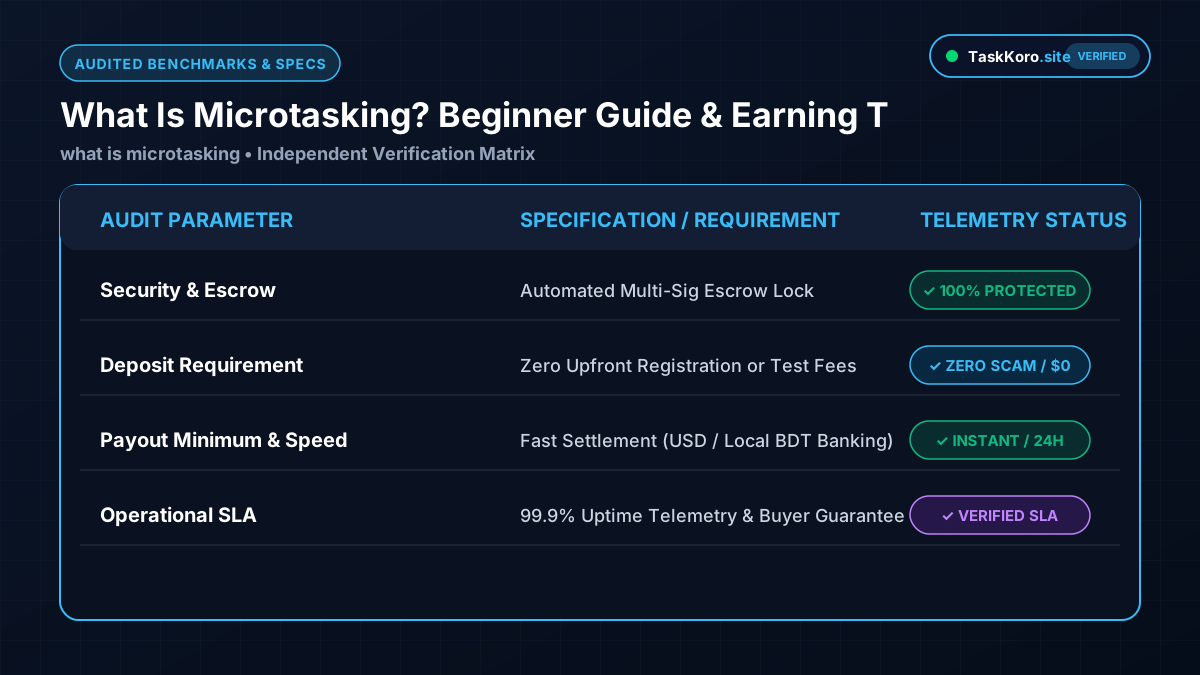
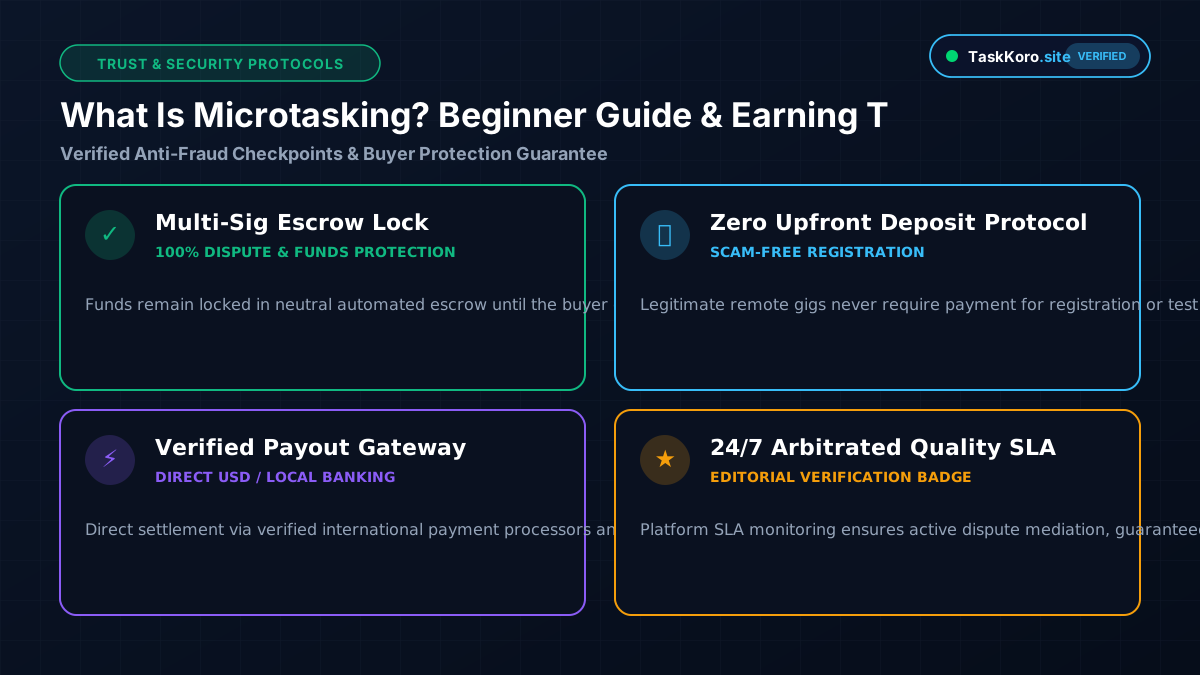
Industry giants like Amazon Mechanical Turk, Clickworker, and Appen are entirely legitimate companies with track records stretching back over a decade. However, because the barrier to entry is low, independent scam sites occasionally mimic microtask platforms to harvest personal data or charge upfront fees. Stick to reputable, well-reviewed platforms that never charge you money to join.
How and when do microtasking platforms pay their workers? +
Payout methods vary by platform but commonly include PayPal, Payoneer, Skrill, direct bank transfer, or gift cards. Minimum withdrawal thresholds can range from as low as $0.01 on platforms like Toloka to $50 on Appen. Payment processing times range from instant approvals to weekly or bi-weekly automated payout cycles.
Can I do microtasking from my smartphone, or do I need a laptop? +
While many platforms have mobile apps for simple tasks like image tagging, audio recording, and quick geolocation checks, higher-paying tasks involving data entry, transcription, and search evaluation generally require a desktop computer or laptop with a physical keyboard for efficiency and screen real estate.
Is income earned from microtasking taxable? +
Yes. Income earned through microtasking is considered self-employment or freelance income in most jurisdictions, including the United States. Platforms may issue a Form 1099 if your earnings cross specific statutory thresholds within a calendar year, and you are legally responsible for tracking and reporting all earnings on your annual tax returns.
Abdullah Hasib
Lead Technology & Editorial Director at TaskKoro.site
Auditing digital remote work platforms, microtask payout verification, and AI workflow security. Dedicated to protecting remote freelancers from fraudulent upfront fee scams.